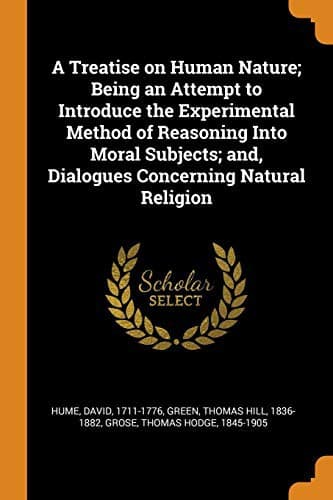
A Treatise of Human Nature: Being an Attempt to Introduce the Experimental Method Into Moral Subjects; and Dialogues Concerning Natural ReligionHume, David
PhilosophyPhilosophy
A Treatise of Human Nature: Being an Attempt to Introduce the Experimental Method Into Moral Subjects; and Dialogues Concerning Natural Religion
Hume, David
Emotions; Ethics; Knowledge, Theory of; Philosophy, English
188. Such a doctrine could not help being at once confused in its
account of reality, and insecure in its doctrine alike of the human
spirit and of God. On the recognition of relations as constituting
the _nature_ of ideas rests the possibility of any tenable theory of
their reality. An isolated idea could be neither real nor unreal.
Apart from a definite order of relation we may suppose (if we like)
that it would _be_, but it would certainly not be real; and as
little could it be unreal, since unreality can only result from the
confusion in our consciousness of one order of relation with another.
It is diversity of relations that distinguishes, for instance, these
letters as they now appear on paper from the same as I imagine them
with my eyes shut, giving each sort its own reality: just as upon
confusion with the other each alike becomes unreal. Thus, though
with Locke simple ideas are necessarily real, we soon find that even
according to him they are not truly so in their simplicity, but only
as related to an external thing producing them. He is right enough,
however inconsistent with himself, in making relation constitute
reality; wrong in limiting this prerogative to the one relation of
externality. When he afterwards, in virtual contradiction to this
limitation, finds the reality of moral and mathematical ideas just
in that sole relation to the mind, as its products, which he had
previously made the source of all unreality, he forces upon us the
explanation which he does not himself give, that unreality does not
lie in either relation as opposed to the other, but in the confusion
of any relation with another. It is for lack of this explanation
that Locke himself, as we have seen, finds in the liveliness
and involuntariness of ideas the sole and sufficient tests (not
_constituents_) of their reality; though they are obviously tests
which put the dreams of a man in a fever upon the same footing with
the ‘impressions’ of a man awake, and would often prove that unreal
after dinner which had been proved real before. There is a well-known
story of a man who in a certain state of health commonly saw a
particular gory apparition, but who, knowing its origin, used to have
himself bled till it disappeared. The reality of the apparition lay,
he knew, in some relation between the circulation of his blood and
his organs of sight, in distinction from the reality existing in the
normal relations of his visual organs to the light: and in his idea,
accordingly, there was nothing unreal, because he did not confuse the
one relation with the other. Locke’s doctrine, however, would allow
of no distinction between the apparition as it was for such a man
and as it would be for one who interpreted it as an actual ‘ghost.’
However interpreted, the liveliness and the involuntariness of the
idea remain the same, as does its relation to an efficient cause. If
in order to its reality the cause must be an ‘outward body,’ then it
Public-domain text, read in full here on John Shaqi.
Reviews
Reviews
No reviews yet
Be the first to share your thoughts on this work.
Elsewhere in the archive
Join the Discussion
Join the discussion
Sign in to leave a comment or review.
Sign InorCreate an account