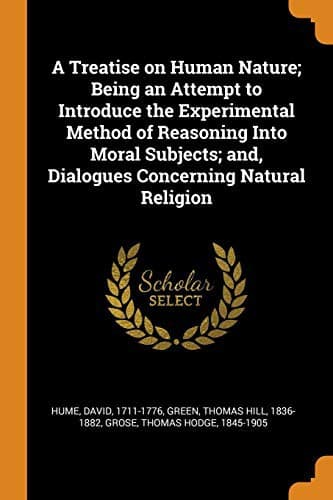
A Treatise of Human Nature: Being an Attempt to Introduce the Experimental Method Into Moral Subjects; and Dialogues Concerning Natural ReligionHume, David
PhilosophyPhilosophy
A Treatise of Human Nature: Being an Attempt to Introduce the Experimental Method Into Moral Subjects; and Dialogues Concerning Natural Religion
Hume, David
Emotions; Ethics; Knowledge, Theory of; Philosophy, English
active power to produce our ideas, which is not to be found in ideas
themselves, for we are conscious that they are inert, nor in matter,
since that is but a name for a bundle of ideas; which must therefore
be in spirit, since of that we are conscious as active; yet not in
the spirit of which we are conscious, since then there would be no
difference between real and imaginary ideas; therefore in a Divine
Spirit, to whom, however, may forthwith be ascribed the attributes of
the spirit of which we are conscious.’ Such is the sum of Berkeley’s
natural theology.
[1] Above, paragraph 180.
[2] [Greek μέγα ζῶον (mega zoon) = great being. Tr.]
... a necessity which Hume does not see. A different turn should have
been given to his idealism, if it was to serve his purpose.
194. From a follower of Hume it of course invites the reply that
he does not see the necessity of an active power at all, to which,
since, according to Berkeley’s own showing, it is no possible ‘idea’
or object of an idea, all his own polemic against the ‘absolute
idea’ of matter is equally applicable; that the efficient power,
of which we profess to be conscious in ourselves, is itself only a
name for a particular feeling or impression which precedes certain
other of our impressions; that, even if it were more than this, the
transition from the spiritual efficiency of which we are conscious
to another, of which it is the special differentia that we are not
conscious of it, would be quite illegitimate, and that thus in
saying that certain feelings are real because, being lively and
involuntary, they must be the work of this unknown spirit, we in
effect say nothing more than that they are real because lively and
involuntary. Against a retort of this kind Berkeley’s theistic armour
is even less proof than Locke’s. His ‘proof of the being of God’
is in fact Locke’s with the sole _nervus probandi_ left out. The
value of Locke’s proof, as an argument from their being something
now to their having been something from eternity, lay, we saw, in
its convertibility into an argument from the world as a system of
relations to a present and eternal subject of those relations. For
its being so convertible there was this to be said, that Locke, with
whatever inconsistency, at least recognised the constitution of
reality by permanent relations, though he treated the mere relation
of external efficiency--that in virtue of which we say of nature that
it consists of bodies outward to and acting on each other--as if it
alone constituted the reality of the world. Berkeley’s reduction
of the ‘primary qualities of matter’ to a succession of feelings
logically effaces this relation, and puts nothing intelligible,
nothing but a name, in its place. The effacement of the distinction
between the real and unreal, which would properly ensue, is only
prevented by bringing back relation to something under the name of
God, either wholly unknown and indeterminate, or else, under a thin
Public-domain text, read in full here on John Shaqi.
Reviews
Reviews
No reviews yet
Be the first to share your thoughts on this work.
Elsewhere in the archive
Join the Discussion
Join the discussion
Sign in to leave a comment or review.
Sign InorCreate an account