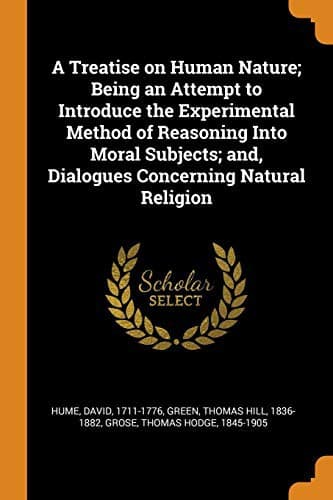
A Treatise of Human Nature: Being an Attempt to Introduce the Experimental Method Into Moral Subjects; and Dialogues Concerning Natural ReligionHume, David
PhilosophyPhilosophy
A Treatise of Human Nature: Being an Attempt to Introduce the Experimental Method Into Moral Subjects; and Dialogues Concerning Natural Religion
Hume, David
Emotions; Ethics; Knowledge, Theory of; Philosophy, English
[1] p. 312, note [Introduction to the Treatise of Human Nature]
[2] See pp. 327 and 375 [Book I, part I., sec. II. and part III. sec.
II.]
[3] p. 310 [Introduction to the Treatise of Human Nature]
[4] p. 318 [Book I, part I., sec. III.]
‘Ideas’ that cannot be so represented must be explained as mere words.
196. All, then, that Hume could find in his mind, when after Locke’s
example he ‘looked into it,’ were, according to his own statement,
feelings with their copies, dividing themselves into two main
orders--those of sensation and those of reflection, of which the
latter, though results of the former, are not their copies. The
question, then, that he had to deal with was, to what impressions
he could reduce those conceptions of relation--of cause and effect,
substance and attribute, and identity--which all knowledge involves.
Failing the impressions of sensation he must try those of reflection,
and failing both he must pronounce such conceptions to be no ‘ideas’
at all, but words misunderstood, and leave knowledge to take its
chance. The vital nerve of his philosophy lies in his treatment
of the ‘association of ideas’ as a sort of process of spontaneous
generation, by which impressions of sensation issue in such
impressions of reflection, in the shape of habitual propensities,’
[1] as will account, not indeed for there being--since there really
are not--but for there seeming to be, those formal conceptions which
Locke, to the embarrassment of his philosophy, had treated as at once
real and creations of the mind.
[1] Pp. 460 and 496 [Book I, part III., sec. XIV. and part IV., sec.
II.]
Hume, taken strictly, leaves no distinction between impressions of
reflection and of sensation.
Public-domain text, read in full here on John Shaqi.
Reviews
Reviews
No reviews yet
Be the first to share your thoughts on this work.
Elsewhere in the archive
Join the Discussion
Join the discussion
Sign in to leave a comment or review.
Sign InorCreate an account