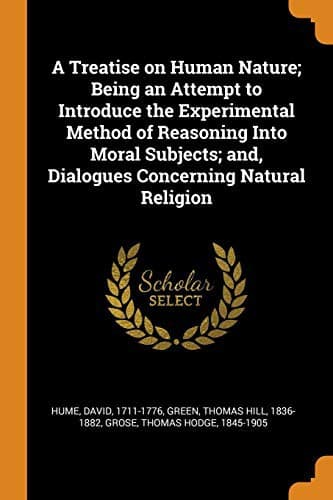
A Treatise of Human Nature: Being an Attempt to Introduce the Experimental Method Into Moral Subjects; and Dialogues Concerning Natural ReligionHume, David
PhilosophyPhilosophy
A Treatise of Human Nature: Being an Attempt to Introduce the Experimental Method Into Moral Subjects; and Dialogues Concerning Natural Religion
Hume, David
Emotions; Ethics; Knowledge, Theory of; Philosophy, English
209. This amounts to a full acceptance of Berkeley’s doctrine
of sense; and the question necessarily arises--such being the
impression, and all ideas being impressions grown weaker, can there
be an idea of relation at all? Is it not open to the same challenge
which Hume offers to those who talk of an idea of substance or of
spirit? ‘It is from some one impression that every real idea is
derived.’ What, then, is the one impression from which the idea of
relation is derived? ‘If it be perceived by the eyes, it must be a
colour; if by the ears, a sound; if by the palate, a taste; and so of
the other senses.’ There remain ‘our passions and emotions;’ but what
passion or emotion is a resemblance, or a proportion, or a relation
of cause and effect?
Only in regard to identity and causation that he sees any difficulty.
These he treats as fictions resulting from ‘natural relations’ of
ideas: _i.e._ from resemblance and contiguity.
210. Respect for Hume’s thoroughness as a philosopher must be
qualified by the observation that he does not attempt to meet this
difficulty in its generality, but only as it affects the relations
of identity and causation. The truth seems to be that he wrote with
Berkeley steadily before his mind; and it was Berkeley’s treatment of
these two relations in particular as not sensible but intelligible,
and his assertion of a philosophic Theism on the strength of their
mere intelligibility, that determined Hume, since it would have been
an anachronism any longer to treat them as sensible, to dispose of
them altogether. The condition of his doing so with success was
that, however unwarrantably, he should treat the other relations
as sensible. The language, which seems to express ideas of the two
questionable relations, he has to account for as the result of
certain impressions of reflection, called ‘propensities to feign,’
which in their turn have to be accounted for as resulting from the
_natural_ relations of ideas according to the definition of these
quoted above, [1] as ‘the qualities by which one idea habitually
introduces another.’ Among these, as we saw, he included not
only resemblance and contiguity in time or place, but ‘cause and
effect.’ ‘There is no relation,’ he says, ‘which produces a stronger
connection in the fancy than this.’ But in this, as in much of the
language which gives the first two Parts their plausibility, he is
taking advantage of received notions on the part of the reader, which
it is the work of the rest of the book to set aside. In any sense,
according to him, in which it differs from usual contiguity, the
relation of cause and effect is itself reducible to a ‘propensity
to feign’ arising from the other natural relations; but when the
reader is told of its producing ‘a strong connection in the fancy,’
he is not apt to think of it as itself nothing more than the product
of such a connection. For the present, however, we have only to
point out that Hume, when he co-ordinates it with the other natural
Public-domain text, read in full here on John Shaqi.
Reviews
Reviews
No reviews yet
Be the first to share your thoughts on this work.
Elsewhere in the archive
Join the Discussion
Join the discussion
Sign in to leave a comment or review.
Sign InorCreate an account