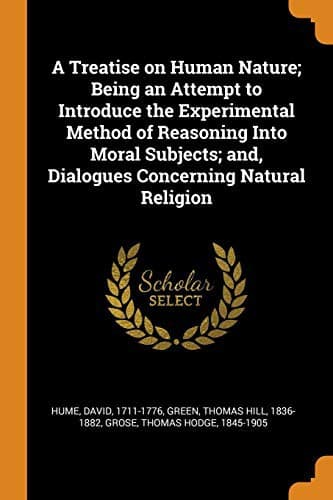
A Treatise of Human Nature: Being an Attempt to Introduce the Experimental Method Into Moral Subjects; and Dialogues Concerning Natural ReligionHume, David
PhilosophyPhilosophy
A Treatise of Human Nature: Being an Attempt to Introduce the Experimental Method Into Moral Subjects; and Dialogues Concerning Natural Religion
Hume, David
Emotions; Ethics; Knowledge, Theory of; Philosophy, English
216. The chapter mentioned concerns the question which arises out of
Locke’s pregnant statement that words and ideas are ‘particular in
their existence’ even when ‘general in their signification.’ From
this statement we saw [1] that Berkeley derived his explanation of
the apparent generality of ideas--the explanation, namely, which
reduces it to a relation, yet not such a one as would affect the
nature of the idea itself, which is and remains ‘particular,’ but
a symbolical relation between it and other particular ideas for
which it is taken to stand. An idea, however, that carries with it a
consciousness of symbolical relation to other ideas, cannot but be
qualified by this relation. The generality must become part of its
‘nature,’ and, accordingly, the distinction between idea and thing
being obliterated, of the nature of things. Thus Berkeley virtually
arrives at a result which renders unmeaning his preliminary exclusion
of universality from ‘the absolute, positive nature or conception of
anything.’ Hume seeks to avoid it by putting ‘custom’ in the place
of the consciousness of symbolical relation. True to his vocation of
explaining away all functions of thought that will not sort with the
treatment of it as ‘decaying sense,’ he would resolve that idea of a
relation between certain ideas, in virtue of which one is taken to
stand for the rest, into the _de facto_ sequence upon one of them of
the rest. Here, as everywhere else, he would make related feelings do
instead of relations of ideas; but whether the related feelings, as
he is obliged to describe them, do not already presuppose relations
of ideas in distinction from feelings, remains to be seen.
[1] Above, paragraphs 182 and 183.
Hume ‘no’ simply. How he accounts for the appearance of there being
such.
Public-domain text, read in full here on John Shaqi.
Reviews
Reviews
No reviews yet
Be the first to share your thoughts on this work.
Elsewhere in the archive
Join the Discussion
Join the discussion
Sign in to leave a comment or review.
Sign InorCreate an account