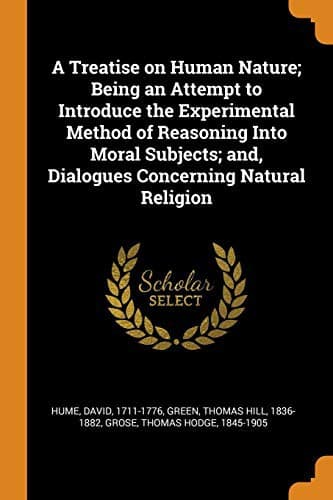
A Treatise of Human Nature: Being an Attempt to Introduce the Experimental Method Into Moral Subjects; and Dialogues Concerning Natural ReligionHume, David
PhilosophyPhilosophy
A Treatise of Human Nature: Being an Attempt to Introduce the Experimental Method Into Moral Subjects; and Dialogues Concerning Natural Religion
Hume, David
Emotions; Ethics; Knowledge, Theory of; Philosophy, English
of this admission with Locke’s own doctrine of ideas as effects of
a causative substance, that he modifies the theory of _physical_
certainty which he inherited. In their treatment of mathematical
truths on the other hand, of propositions involving relations of
distance, quantity and degree, a fundamental discrepancy appears
between the two writers. The ground of certainty, which Hume admits
in regard to propositions of this order, must be examined before we
can appreciate his theory of probability as it affects the relations
of cause and substance.
[1] See above, paragraphs 45 and 97.
... and does not admit opposition of mathematical to physical
certainty--here following Berkeley.
227. It has been shown [1] that Locke’s opposition of mathematical to
physical certainty, with his ascription to the former of instructive
generality on the ground of its bare ideality--the ‘ideal’ in this
regard being opposed to what is found in sensation--strikes at the
very root of his system. It implies that thought can originate, and
that what it originates is in some sort real--nay, as being nothing
else than the ‘primary qualities of matter,’ is the source of all
other reality. Here was an alien element which ‘empiricism’ could not
assimilate without changing its character. Carrying such a conception
along with it, it was already charged with an influence which must
ultimately work its complete transmutation by compelling, not the
admission of an ideal world of guess and aspiration alongside of
the empirical, but the recognition of the empirical as itself ideal
The time for this transmutation, however, was not yet. Berkeley, in
over-hasty zeal for God, had missed that only true way of finding God
in the world which lies in the discovery that the world is Thought.
Having taken fright at the ‘mathematical Atheism,’ which seemed to
grow out of the current doctrines about primary qualities of matter,
instead of applying Locke’s own admissions to show that these were
intelligible and merely intelligible, he fancied that he had won the
battle for Theism by making out that they were merely feelings or
sequences of feelings. From him Hume got the text for all he had to
say against the metaphysical mathematicians; but, for the reason that
Hume applied it with no theological interest, its true import becomes
more apparent with him than with Berkeley.
[1] See above, paragraphs 117 and 125.
His criticisms of the doctrine of primary qualities.
Public-domain text, read in full here on John Shaqi.
Reviews
Reviews
No reviews yet
Be the first to share your thoughts on this work.
Elsewhere in the archive
Join the Discussion
Join the discussion
Sign in to leave a comment or review.
Sign InorCreate an account