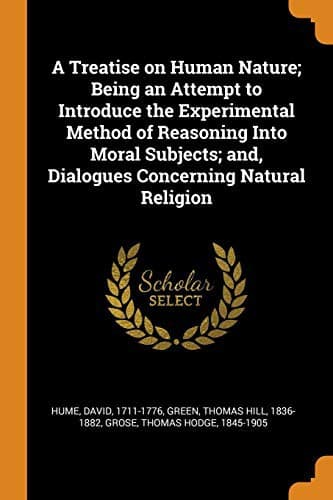
A Treatise of Human Nature: Being an Attempt to Introduce the Experimental Method Into Moral Subjects; and Dialogues Concerning Natural ReligionHume, David
PhilosophyPhilosophy
A Treatise of Human Nature: Being an Attempt to Introduce the Experimental Method Into Moral Subjects; and Dialogues Concerning Natural Religion
Hume, David
Emotions; Ethics; Knowledge, Theory of; Philosophy, English
229. Hume makes a show of getting rid of this see-saw. Instead of
assuming at once the reality of sensation on the strength of its
relation to the primary qualities and the reality of these on the
strength of their being given in tactual experience, he pronounces
sensations alone the real, to which the primary qualities must be
reduced, if they are not to disappear altogether. ‘If colours,
sounds, tastes, and smells be merely perceptions, nothing we
can conceive is possessed of a real, continued, and independent
existence’. [1] That they are perceptions is of course undoubted.
The question is, whether there is a real something beside and
beyond them, contrast with which is implied in speaking of them
as ‘_merely_ perceptions.’ The supposed qualities of such a real
are ‘motion, extension, and solidity’. [2] To modes of these the
other primary qualities enumerated by Locke are reducible; and of
these again motion and extension, according to Locke’s account no
less than Hume’s own, presuppose solidity. What then do we assert
of the real, in contrast with which we talk of perception, as
_mere_ perception, when we say that it is solid? ‘In order to form
an idea of solidity we must conceive two bodies pressing on each
other without any penetration. ... Now, what idea do we form of
these bodies? ... To say that we conceive them as solid is to run
on _ad infinitum_. To affirm that we paint them out to ourselves as
extended, either resolves them all into a false idea or returns in a
circle; extension must necessarily be conceived either as coloured,
which is a false idea, [3] or as solid, which brings us back to the
first question.’ Of solidity, then, the ultimate determination of
the supposed real, there is ‘no idea to be formed’ apart from those
perceptions to which, as independent of our senses, it is opposed.
‘After exclusion of colours, sounds, heat and cold from the rank of
external existences, there remains nothing which can afford us a just
and consistent idea of body.’
[1] p. 513 [Book I, part IV., sec. IV.]
[2] Ibid.
[3] ‘A false idea,’ that is, according to the doctrine that extension
is a primary quality, while colour is only an idea of a secondary
quality, not resembling the quality as it is in the thing.
Locke’s shuffle of ‘body,’ ‘solidity,’ and ‘touch,’ fairly exposed.
Public-domain text, read in full here on John Shaqi.
Reviews
Reviews
No reviews yet
Be the first to share your thoughts on this work.
Elsewhere in the archive
Join the Discussion
Join the discussion
Sign in to leave a comment or review.
Sign InorCreate an account