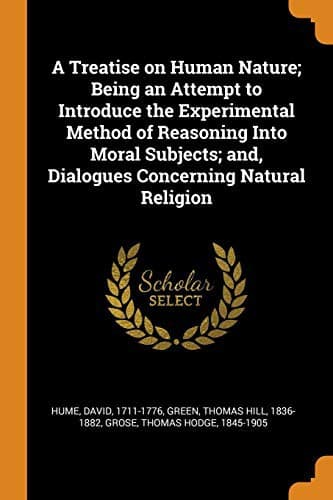
A Treatise of Human Nature: Being an Attempt to Introduce the Experimental Method Into Moral Subjects; and Dialogues Concerning Natural ReligionHume, David
PhilosophyPhilosophy
A Treatise of Human Nature: Being an Attempt to Introduce the Experimental Method Into Moral Subjects; and Dialogues Concerning Natural Religion
Hume, David
Emotions; Ethics; Knowledge, Theory of; Philosophy, English
and the presentation of that occurrence by the self-conscious subject
to itself; and, if only he had known what he was about in the
recognition, might have anticipated Kant’s distinction between the
matter and form of sensation. In the Second Book, however, he will
neither say explicitly that space is an impression of colour or a
compound of colours--that would be to extinguish geometry; nor yet
that it is impression of sense separate from that of colour--that
would lay him open to the retort that he was virtually introducing
a sixth sense; nor on the other hand will he boldly avow of it, as
he afterwards does of body, that it is a fiction. He denies that it
is a separate impression, so far as that is necessary for avoiding
the challenge to specify the sense through which it is received;
he distinguishes it from a mere impression of sight, when it is
necessary to avoid its simple identification with colour. By speaking
of it as ‘the manner in which objects exist’--so long as he is not
confronted with the declarations of the Fourth Book or with the
question how, the objects being impressions, their order of existence
can be at once that of succession in time and of co-existence in
space--he gains the credit for it of being a datum of sight, yet
so far distinct from colour as to be a possible ‘foundation for an
abstract idea,’ representative also of objects not coloured at all
but tangible. At the same time, if pressed with the question how it
could be an impression of sight and yet not interchangeable with
colour, he could put off the questioner by reminding him that he
never made it a ‘separate or distinct impression, but one of the
manner in which objects exist.’
[1] Pp. 319, 326, 332, 335, 518. [Book I, part I., sec. IV and VII,
part II, sec. I, and part IV., sec. V.]
[2] P. 346. [Book I, part II., sec. IV.]
[3] P. 480. [Book I, part IV., sec. II.]
In his account of the idea as _abstract_, Hume really introduces
distinction between feeling and conception;
Public-domain text, read in full here on John Shaqi.
Reviews
Reviews
No reviews yet
Be the first to share your thoughts on this work.
Elsewhere in the archive
Join the Discussion
Join the discussion
Sign in to leave a comment or review.
Sign InorCreate an account