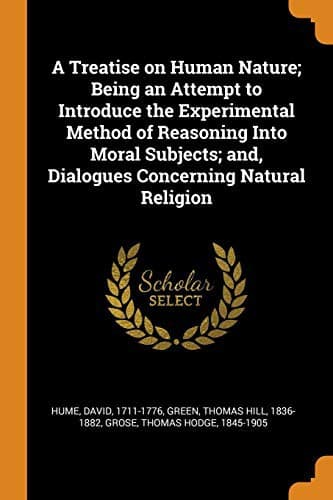
A Treatise of Human Nature: Being an Attempt to Introduce the Experimental Method Into Moral Subjects; and Dialogues Concerning Natural ReligionHume, David
PhilosophyPhilosophy
A Treatise of Human Nature: Being an Attempt to Introduce the Experimental Method Into Moral Subjects; and Dialogues Concerning Natural Religion
Hume, David
Emotions; Ethics; Knowledge, Theory of; Philosophy, English
... yet avoids appearance of doing so, by treating ‘consideration’ of
the relations of a felt thing as if it were itself the feeling.
253. It is thus by playing fast and loose with the difference between
feeling and conception that Hume is able, when the character of
extension as an intelligible relation is urged, to reply that it is
the same with the feeling of colour; and on the other hand, when
asked how there then can be an abstract idea of it, to reply that
this does not mean a separate idea, but coloured objects considered
under a certain relation, viz. under that which consists in the
disposition of their parts. The most effective way of meeting him on
his own ground is to ask him how it is, since ‘consideration’ can
only mean a succession of ideas, and ideas are fainter impressions,
that extension, being one and the same impression with colour, can
by any ‘consideration’ become so different from it as to constitute
a resemblance to objects that are not coloured at all. The true
explanation, according to his own terminology, would be that the
resemblance between the white globe and all other globes, being
a resemblance not of impressions but of such relations between
impressions as do not ‘depend on the nature of the impressions’
related, is unaffected by the presence or absence of colour or any
other sensation. Of such relations, however, there can properly,
if ideas are fainter impressions, be no ideas at all. In regard
to those of cause and identity Hume virtually admits this; but
the ‘propensities to feign’ by which in the case of these latter
relations he tries to account for the appearance of there being
ideas of them, cannot plausibly be applied to relations in space and
time, of which, as we shall see, ideas must be assumed in order to
account for the ‘fictions’ of body and necessary connexion. Since
then they cannot be derived from any separate impression without the
introduction in effect of a sixth sense, and since all constitutive
action of thought as distinct from feeling is denied by Hume, the
only way to save appearances is to treat the order in which a
multitude of impressions present themselves as the same with each
impression, even though immediately afterwards it may have to be
confessed, that it is so independent of the nature of any or all of
the impressions as to be the foundation of an abstract idea, which is
representative of other impressions having nothing whatever in common
with them but the order of appearance. This once allowed--an abstract
idea having been somehow arrived at which is not really the copy of
any impression--it is easy to argue back from the abstract idea to an
impression, and because there is an idea of the composition of points
to substitute a ‘composition of coloured points’ for colour as the
original impression. From such impression, being already extension,
the idea of extension can undoubtedly be abstracted.
Summary of contradictions in his account of extension.
Public-domain text, read in full here on John Shaqi.
Reviews
Reviews
No reviews yet
Be the first to share your thoughts on this work.
Elsewhere in the archive
Join the Discussion
Join the discussion
Sign in to leave a comment or review.
Sign InorCreate an account