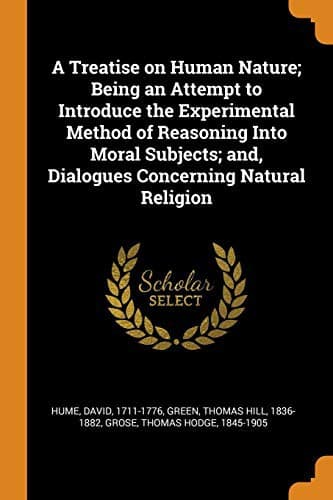
A Treatise of Human Nature: Being an Attempt to Introduce the Experimental Method Into Moral Subjects; and Dialogues Concerning Natural ReligionHume, David
PhilosophyPhilosophy
A Treatise of Human Nature: Being an Attempt to Introduce the Experimental Method Into Moral Subjects; and Dialogues Concerning Natural Religion
Hume, David
Emotions; Ethics; Knowledge, Theory of; Philosophy, English
is implied when the impressions are counted and pronounced so many.
Thus when Hume tells us that a single object, by being ‘multiplied
in order to be conceived at once as existent in different points of
time,’ gives us the idea of number, we are forced to ask him what
precisely it is which thus, being one, can become manifold. Is it a
‘unite that can exist alone’? That, having no parts, cannot become
manifold by resolution. ‘But it may by repetition?’ No, for it is
a separate impression, and the repetition of an impression cannot
co-exist, so as to form one sum, with its former occurrence. ‘But it
may be _thought of_ as doing so?’ No, for that, according to Hume,
could only mean that feelings might concur in a fainter stage though
they could not in a livelier. Is the single object then a unite which
already consists of parts? But that is a ‘fictitious denomination,’
and presupposes the very idea of number that has to be accounted for.
[1] P. 338. [Book I, part II., sec. II.]
Idea of time even more unaccountable on Hume’s principles.
259. The impossibility of getting number, as a many-in-one, out of
the succession of feelings, so long as the self is treated as only
another name for that succession, is less easy to disguise when the
supposed units are not merely given in succession, but are actually
the moments of the succession; in other words, when time is the
many-in-one to be accounted for. How can a multitude of feelings
of which no two are present together, undetermined by relation to
anything other than the feelings, be at the same time a consciousness
of the relation between the moments in which the feelings are given,
or of a sum which these moments form? How can there be a relation
between ‘objects’ of which one has ceased before the other has
begun to exist? ‘For the same reason,’ says Hume, ‘that the year
1737 cannot concur with the present year 1738, every moment must be
distinct from, and posterior or antecedent to, another’. [1] How
then can the present moment form one sum with all past moments,
the present year with all past years; the sum which we indicate
by the number 1738? The answer of common sense of course will be
that, though the feeling of one moment is really past before that
of another begins, yet thought retains the former, and combining
it with the latter, gets the idea of time both as a relation and
as a sum. Such an answer, however, implies that the retaining and
combining thought is other than the succession of the feelings, and
while it takes this succession to be the reality, imports into it
that determination by the relations of past and present which it can
only derive from the retaining and combining thought opposed to it.
It is thus both inconsistent with Hume’s doctrine, which allows no
such distinction between thought, _i.e._ the succession of ideas,
and the succession of impressions, and inconsistent with itself. Yet
Hume by disguising both inconsistencies contrives to avail himself
of it.
Public-domain text, read in full here on John Shaqi.
Reviews
Reviews
No reviews yet
Be the first to share your thoughts on this work.
Elsewhere in the archive
Join the Discussion
Join the discussion
Sign in to leave a comment or review.
Sign InorCreate an account