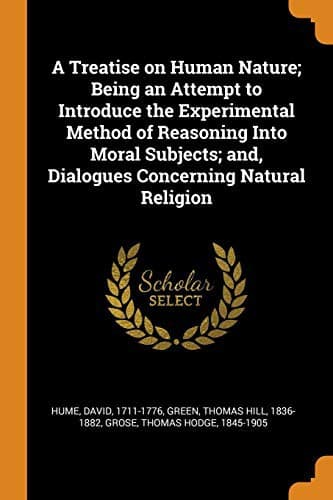
A Treatise of Human Nature: Being an Attempt to Introduce the Experimental Method Into Moral Subjects; and Dialogues Concerning Natural ReligionHume, David
PhilosophyPhilosophy
A Treatise of Human Nature: Being an Attempt to Introduce the Experimental Method Into Moral Subjects; and Dialogues Concerning Natural Religion
Hume, David
Emotions; Ethics; Knowledge, Theory of; Philosophy, English
270. It is very plain that in this passage Hume is riding two horses
at once. He is trying so to combine the notion of the constitution
of space by impressions with that of its constitution by points, as
to disguise the real meaning of each. In what lies the difference
between the feelings of colour, of which we have shown that they
cannot without contradiction be supposed to ‘make up extension,’
and ‘coloured points or corpuscles’? Unless the points, as points,
mean something, the substitution of coloured points for colours
means nothing. But according to Hume the point is nothing except as
an impression of sight or touch. If then we refuse his words the
benefit of an interpretation which his doctrine excludes, we find
that there remains simply the impossible supposition that space
consists of feelings. This result cannot be avoided, unless in
speaking of space as composed of points, we understand by the point
that which is definitely other than an impression. Thus the question
which Hume puts--If extension is made up of parts, and these, being
indivisible, are unextended, what are they?--really remains untouched
by his ostensible answer. Such a question indeed to a philosophy like
Locke’s, which, ignoring the constitution of reality by relations,
supposed real things to be first found and then relations to be
superinduced by the mind--much more to one like Hume’s, which left no
mind to superinduce them--was necessarily unanswerable.
True way of dealing with the question.
271. In truth, extension is the relation of mutual externality. The
constituents of this relation have not, as such, any nature but what
is given by the relation. If in Hume’s language we ‘separate each
from the others and, considering it apart, form a judgment of its
nature and qualities,’ by the very way we put the problem we render
it insoluble or, more properly, destroy it; for, thus separated,
they have no nature. It is this that we express by the proposition
which would otherwise be tautological, that extension is a relation
between extended points. The ‘points’ are the simplest expression
for those coefficients to the relation of mutual externality, which,
as determined by that relation and no otherwise, have themselves the
attribute of being extended and that only. If it is asked whether
the points, being extended, are therefore divisible, the answer must
be twofold. _Separately_ they are not divisible, for separately they
are nothing. Whether, as determined by mutual relation, they are
divisible or no, depends on whether they are treated as forming a
quantum or no. If they are not so treated, we cannot with propriety
pronounce them to be either further divisible or not so, for the
question of divisibility has no application to them. But being
perfectly homogeneous with each other and with that which together
they constitute, they are susceptible of being so treated, and are
so treated when, with Hume in the passage before us, we speak of
Public-domain text, read in full here on John Shaqi.
Reviews
Reviews
No reviews yet
Be the first to share your thoughts on this work.
Elsewhere in the archive
Join the Discussion
Join the discussion
Sign in to leave a comment or review.
Sign InorCreate an account