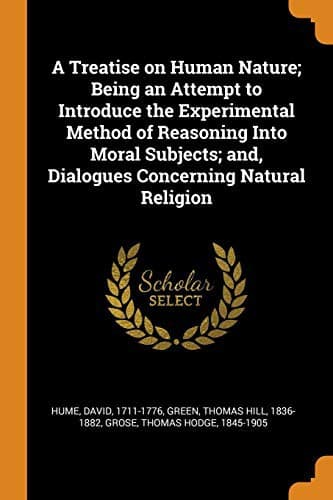
A Treatise of Human Nature: Being an Attempt to Introduce the Experimental Method Into Moral Subjects; and Dialogues Concerning Natural ReligionHume, David
PhilosophyPhilosophy
A Treatise of Human Nature: Being an Attempt to Introduce the Experimental Method Into Moral Subjects; and Dialogues Concerning Natural Religion
Hume, David
Emotions; Ethics; Knowledge, Theory of; Philosophy, English
281. We now know the nature of that preliminary manipulation which
‘impressions and ideas’ have to undergo, if their association is to
yield the result which Hume requires--if through it the succession
of feelings is to become a knowledge of things and their relations.
Such a result was required as the only means of maintaining together
the two characteristic positions of Locke’s philosophy; that,
namely, the only world we can know is the world of ‘ideas,’ and
that thought cannot originate ideas. Those relations, which Locke
had inconsistently treated at once as intellectual superinductions
and as ultimate conditions of reality, must be dealt with by one
of two methods. They must be reduced to impressions where that
could plausibly be done: where it could not, it must be admitted
that we have no ideas of them, but only ‘tendencies to suppose’
that we have such, arising from the association, through ‘natural
relations,’ of the ideas that we have. So dexterously does Hume work
the former method that, of all the ‘philosophical relations’ which
he recognizes, only Identity and Causation remain to be disposed of
by the latter; and if the other relations--resemblance, time and
space, proportion in quantity and degree in quality--could really
be admitted as data of sense, there would at least be a possible
basis for those ‘tendencies to suppose’ which, in the absence of any
corresponding ideas, the terms ‘Identity’ and ‘Causation’ must be
taken to represent. But, as we have shown, they can only be claimed
for sense, if sense is so far one with thought--one not by conversion
of thought into sense but by taking of sense into thought--as that
Hume’s favourite appeals to sense against the reality of intelligible
relations become unmeaning. They may be ‘impressions,’ there may
be ‘impressions of them,’ but only if we deny of the impression
what Hume asserts of it, and assert of it what he denies--only
if we understand by ‘impression’ not an ‘internal and perishing
existence;’ not that which, if other than taste, colour, sound, smell
or touch, must be a ‘passion or emotion ‘; _not_ that which carries
no reference to an object other than itself, and which must _either_
be single _or_ compound; but something permanent and constituted
by permanently coexisting parts; something that may ‘be conjoined
with’ any feeling, because it is none; that always carries with it a
reference to a subject which it is not but of which it is a quality;
and that is both many and one, since ‘in its simplicity it contains
many different resemblances and relations.’
Public-domain text, read in full here on John Shaqi.
Reviews
Reviews
No reviews yet
Be the first to share your thoughts on this work.
Elsewhere in the archive
Join the Discussion
Join the discussion
Sign in to leave a comment or review.
Sign InorCreate an account