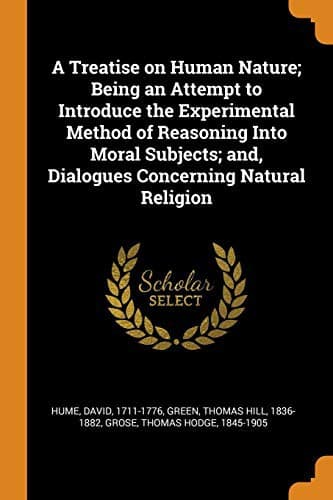
A Treatise of Human Nature: Being an Attempt to Introduce the Experimental Method Into Moral Subjects; and Dialogues Concerning Natural ReligionHume, David
PhilosophyPhilosophy
A Treatise of Human Nature: Being an Attempt to Introduce the Experimental Method Into Moral Subjects; and Dialogues Concerning Natural Religion
Hume, David
Emotions; Ethics; Knowledge, Theory of; Philosophy, English
Yet seems other than this. How this appearance is to be explained.
286. This relation which, going beyond our actual experience, we seem
to infer as the explanation of invariable contiguity in place or time
of certain impressions, and from which again we seem to infer the
identity of an object of which the perception has been interrupted,
is what we call necessary connection. It is their supposed necessary
connection which distinguishes objects related as cause and effect
from those related merely in the way of contiguity and succession,
[1] and it is a like supposition that leads us to infer what we do
not see or remember from what we do. If then the reduction of thought
and the intelligible world to feeling was to be made good, this
supposition, not being an impression of sense or a copy of such, must
be shown to be an ‘impression of reflection,’ according to Hume’s
sense of the term, _i.e._ a tendency of the soul, analogous to desire
and aversion, hope and fear, derived from impressions of sense but
not copied from them; [2] and the inference which it determines
must be shown to be the work of imagination, as affected by such
impression of reflection. This in brief is the purport of Hume’s
doctrine of causation.
[1] P. 376. [Book I, part III., sec. II.]
[2] Above, par. 195.
Inference, resting on supposition of necessary connection, to be
explained before that connection.
287. After his manner, however, he will go about with his reader. The
supposed ‘objective basis’ of knowledge is to be made to disappear,
but in such a way that no one shall miss it. So dexterously, indeed,
is this done, that perhaps to this day the ordinary student of Hume
is scarcely conscious of the disappearance. Hume merely announces to
begin with that he will ‘postpone the direct survey of this question
concerning the nature of necessary connection,’ and deal first with
these other two questions, viz. (1) ‘For what reason we pronounce it
_necessary_ that everything whose existence has a beginning, should
also have a cause?’ and (2) ‘Why we conclude that such particular
causes must _necessarily_ have such particular effects; and what is
the nature of that _inference_ we draw from the one to the other, and
of the _belief_ we repose in it?’ That is to say, he will consider
the inference from cause or effect, before he considers cause and
effect as a relation between objects, on which the inference is
supposed to depend. Meanwhile necessary connection, as a relation
between objects, is naturally supposed in some sense or other to
survive. In _what_ sense, the reader expects to find when these two
preliminary questions have been answered. But when they have been
answered, necessary connection, as a relation between objects, turns
out to have vanished.
Account of the inference given by Locke and Clarke rejected.
Public-domain text, read in full here on John Shaqi.
Reviews
Reviews
No reviews yet
Be the first to share your thoughts on this work.
Elsewhere in the archive
Join the Discussion
Join the discussion
Sign in to leave a comment or review.
Sign InorCreate an account