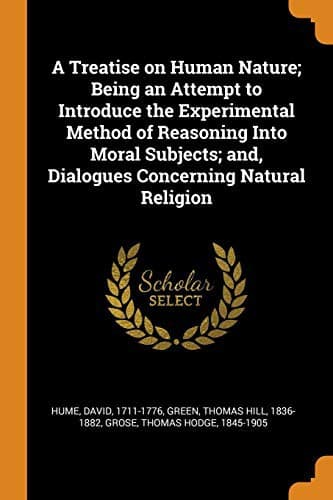
A Treatise of Human Nature: Being an Attempt to Introduce the Experimental Method Into Moral Subjects; and Dialogues Concerning Natural ReligionHume, David
PhilosophyPhilosophy
A Treatise of Human Nature: Being an Attempt to Introduce the Experimental Method Into Moral Subjects; and Dialogues Concerning Natural Religion
Hume, David
Emotions; Ethics; Knowledge, Theory of; Philosophy, English
291. ‘’Tis evident that all reasonings from causes or effects
terminate in conclusions concerning matter of fact, _i.e._ concerning
the existence of objects or of their qualities’; [1] in other words,
in belief. If this meant a new idea, an idea that we have not
previously had, it would follow that inference could really carry us
beyond sense, that there could be an idea not copied from any prior
impression. But according to Hume it does not mean this. ‘The idea
of existence is the very same with the idea of what we conceive to
be existent;’ [2] and not only so, ‘the _belief_ of existence joins
no new ideas to those which compose the idea of the object. When I
think of God, when I think of him as existent, and when I believe him
to be existent, my idea of him neither increases nor diminishes’.
[3] In what then lies the difference between incredulity and belief;
between an ‘idea assented to,’ or an object believed to exist, and
a fictitious object or idea from which we dissent? The answer is,
‘not in the parts or composition of the idea, but in the manner
of conceiving it,’ which must be understood to mean the manner of
‘feeling’ it; and this difference is further explained to lie in ‘the
superior force, or vivacity, or steadiness’ with which it is felt.’
[4] We are thus brought to the further question, how it is that this
‘superior vivacity’ belongs to the inferred idea when we ‘reason’
from cause to effect or from effect to cause. The answer here is
that the ‘impression of the memory or senses,’ which in virtue of
a ‘natural relation’ suggests the idea, also ‘communicates to it a
share of its force or vivacity.’
[1] P. 394. [Book I, part III., sec. VII.]
[2] P. 370. [Book I, part II., sec. VI.]
[3] P. 395. [Book I, part III., sec. II.]
[4] P. 398 [Book I, part III., sec. VII.]. Cf. above, par. 170, for
the corresponding view in Berkeley.
It results that necessary connection is an impression of reflection,
_i.e._, a propensity to the transition described.
Public-domain text, read in full here on John Shaqi.
Reviews
Reviews
No reviews yet
Be the first to share your thoughts on this work.
Elsewhere in the archive
Join the Discussion
Join the discussion
Sign in to leave a comment or review.
Sign InorCreate an account