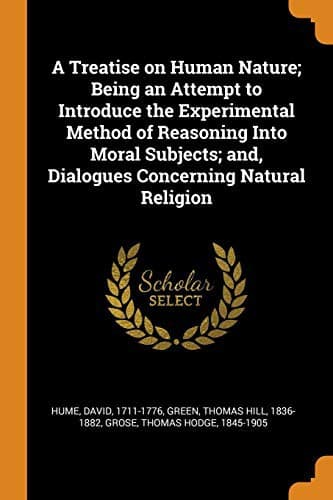
A Treatise of Human Nature: Being an Attempt to Introduce the Experimental Method Into Moral Subjects; and Dialogues Concerning Natural ReligionHume, David
PhilosophyPhilosophy
A Treatise of Human Nature: Being an Attempt to Introduce the Experimental Method Into Moral Subjects; and Dialogues Concerning Natural Religion
Hume, David
Emotions; Ethics; Knowledge, Theory of; Philosophy, English
293. The sequence of ideas, which this propensity determines, clearly
does not involve any inference ‘beyond sense,’ ‘from the known to the
unknown,’ ‘from instances of which we have had experience, to those
of which we have had none,’ any more than does any other ‘recurrence
of an idea’--which, as we have seen, merely means, according to Hume,
the return of a feeling at a lower level of intensity after it has
been felt at a higher. The idea which we speak of as an inferred
cause or effect is only an ‘instance of which we have no experience’
in the sense of being _numerically different_ from the similar
ideas, whose previous constant association with an impression like
the given one, determines the ‘inference;’ but in the same sense
the ‘impression’ which I now feel on putting my hand to the fire
is different from the impressions previously felt under the same
circumstances, and I do not for that reason speak of this impression
as an instance of which I have had no experience. Thus Hume, though
retaining the received phraseology in reference to the ‘conclusion
from any particular cause to any particular effect’--phraseology
which implies that prior to the inference the object inferred is in
some sense unknown or unexperienced--yet deprives it of meaning by a
doctrine which makes inference, as he himself puts it, ‘a species of
sensation,’ ‘an unintelligible instinct of our souls,’ ‘more properly
an act of the sensitive than of the cogitative part of our natures’
[1]--which in fact leaves no ‘part of our natures’ to be cogitative
at all.
[1] Pp. 404, 475, and 471. [Book I, part III., sec. VIII., part IV.
sec. I. and part III., sec. XVI.]
Nor determined by any objective relation.
294. We are not entitled then, it would seem, to say that any
inference to matter of fact, any proof of an ‘instructive
proposition,’--as distinct from the conclusion of a syllogism,
which is simply derived from the analysis of a proposition already
conceded,--rests on the relation of cause and effect. Such language
implies that the relation is other than the inference, whereas, in
fact, they are one and the same, each being merely a particular
sort of sequence of feeling upon feeling--that sort of which the
characteristic is that, when the former feeling only has the maximum
of vivacity, it still, owing to the frequency with which it has been
attended by the other, imparts to it a large, though less, amount of
vivacity. This is the naked result to which Hume’s doctrine leads--a
result which, thus put, might have set men upon reconsidering the
first principles of the Lockeian philosophy. But he wished to find
acceptance, and would not so put it. A consideration of the points
in which he had to sacrifice consistency to plausibility--since he
was always consistent where he decently could be--will lead us to the
true αἴτιον τοῦ ψευδοῦς [1], the impossibility on his principles of
explaining the world of knowledge.
Public-domain text, read in full here on John Shaqi.
Reviews
Reviews
No reviews yet
Be the first to share your thoughts on this work.
Elsewhere in the archive
Join the Discussion
Join the discussion
Sign in to leave a comment or review.
Sign InorCreate an account