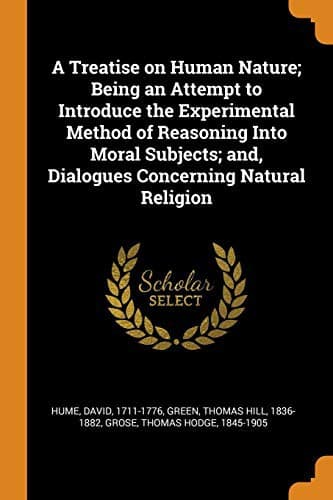
A Treatise of Human Nature: Being an Attempt to Introduce the Experimental Method Into Moral Subjects; and Dialogues Concerning Natural ReligionHume, David
PhilosophyPhilosophy
A Treatise of Human Nature: Being an Attempt to Introduce the Experimental Method Into Moral Subjects; and Dialogues Concerning Natural Religion
Hume, David
Emotions; Ethics; Knowledge, Theory of; Philosophy, English
299. The modern followers of Hume may perhaps seek refuge in the
consideration that though the relation of cause and effect between
objects is not one in the way of resemblance or one of which the
idea is given by comparison of the objects, it yet results from
comparisons, which may be supposed to act like chemical substances
whose combination produces a substance with properties quite
different from those of the combined substances, whether taken
separately or together. Some anticipation of such a solution,
it may be said, we find in Hume himself, who is aware that from
the repetition of impressions of sense and their ideas new,
heterogeneous, impressions--those of ‘reflection’--are formed. Of
this more will be said when we come to Hume’s treatment of cause
and effect as a ‘natural relation.’ For the present we have to
enquire what exactly is implied in the comparisons from which this
heterogeneous idea of relation is derived. If we look closely we
shall find that they presuppose a consciousness of relations as
little reducible to resemblance, _i.e._ as little the result of
comparison, as that of cause and effect itself. It has been already
noticed how Hume treats the judgment of proportion between figures
as a mere affair of sense, because such relation depends entirely
on the ideas compared, without reflecting that the existence of the
figures presupposes those relations of space to which, because (as
he admits) they do not depend on the comparison of ideas, the only
excuse for reckoning any relation sensible does not apply. In the
same way he contents himself with the fact that the judgment of cause
and effect implies a comparison of present with past experience, and
may thus be brought under his definition of ‘philosophical relation,’
without observing that the experiences compared are themselves by
no means reducible to comparison. We judge that an object, which we
now find to be precedent and contiguous to another, is its cause
when, comparing present experience with past, we find that it always
has been so. That in effect is Hume’s account of the relation,
‘considered as a philosophical one:’ and it implies that the
constitution of the several experiences compared involves two sorts
of relation which Hume admits not to be derived from comparison,
_(a)_ relation in time and place, _(b)_ relation in the way of
identity.
Observation of succession already goes beyond sense.
Public-domain text, read in full here on John Shaqi.
Reviews
Reviews
No reviews yet
Be the first to share your thoughts on this work.
Elsewhere in the archive
Join the Discussion
Join the discussion
Sign in to leave a comment or review.
Sign InorCreate an account