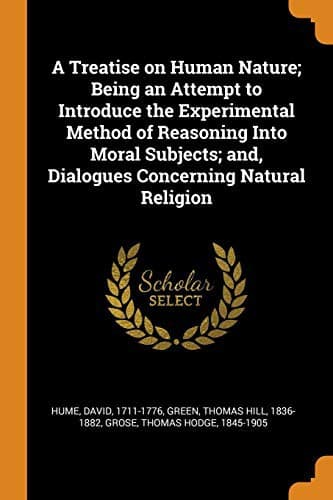
A Treatise of Human Nature: Being an Attempt to Introduce the Experimental Method Into Moral Subjects; and Dialogues Concerning Natural ReligionHume, David
PhilosophyPhilosophy
A Treatise of Human Nature: Being an Attempt to Introduce the Experimental Method Into Moral Subjects; and Dialogues Concerning Natural Religion
Hume, David
Emotions; Ethics; Knowledge, Theory of; Philosophy, English
306. Having thus in effect imported all three ‘fictions of
imagination’--identity, continued existence, and existence distinct
from perception--into the original ‘perception,’ Hume, we may think,
might have saved himself the trouble of treating them as separate and
successive formations. Unless he had so treated them, however, his
‘natural history’ of consciousness would have been far less imposing
than it is. The device, by which he represents the ‘vulgar’ belief in
the reality of the felt thing as a belief that the mere feeling is
the real object, enables him also to represent the identity, which
a smooth transition along closely resembling sensations leads us
to suppose, as still merely identity of a _perception_. ‘The very
image which is present to the senses is with us the real body; and
’tis to these interrupted images we ascribe a perfect identity’.
[1] The identity lying thus in the images or appearances, not in
anything to which they are referred, a further fiction seems to be
required by which we may overcome the contradiction between the
interruption of the appearances and their identity--the fiction
of ‘a continued being which may fill the intervals’ between the
appearances. [2] That a ‘propension’ towards such a fiction would
naturally arise from the uneasiness caused by such a contradiction,
we may readily admit. The question is how the propension can be
satisfied by a supposition which is merely another expression for
one of the contradictory beliefs. What difference is there between
the appearance of a perception and its existence, that interruption
of the perception, though incompatible with uninterruptedness in its
appearance, should not be so with uninterruptedness in its existence?
It may be answered that there is just the difference between relation
to a feeling subject and relation to a thinking one--between relation
to a consciousness which is in time, or successive, and relation to
a thinking subject which, not being itself in time, is the source of
that determination by permanent conditions, which is what is meant by
the real existence of a perceived thing. But to Hume, who expressly
excludes such a subject--with whom ‘it exists’ = ‘it is felt’--such
an answer is inadmissible. He can, in fact, only meet the difficulty
by supposing the existence of unfelt feelings, of unperceived
perceptions. The appearance of a perception is its presence to
‘what we call a mind,’ which ‘is nothing but a heap or collection
of different perceptions, united together by certain relations, and
supposed, though falsely, to be endowed with a perfect simplicity
and identity’. [3] To consider a perception, then, as existing
though not appearing is merely to consider it as detached from
this ‘heap’ of other perceptions, which, on Hume’s principle that
whatever is distinguishable is separable, is no more impossible than
to distinguish one perception from all others. [4] In fact, however,
Public-domain text, read in full here on John Shaqi.
Reviews
Reviews
No reviews yet
Be the first to share your thoughts on this work.
Elsewhere in the archive
Join the Discussion
Join the discussion
Sign in to leave a comment or review.
Sign InorCreate an account