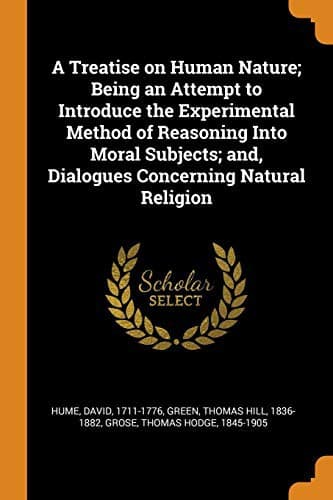
A Treatise of Human Nature: Being an Attempt to Introduce the Experimental Method Into Moral Subjects; and Dialogues Concerning Natural ReligionHume, David
PhilosophyPhilosophy
A Treatise of Human Nature: Being an Attempt to Introduce the Experimental Method Into Moral Subjects; and Dialogues Concerning Natural Religion
Hume, David
Emotions; Ethics; Knowledge, Theory of; Philosophy, English
318. It is this essential distinction between the sequence of
feeling upon feeling for a sentient subject and the relation which
to a thinking subject this sequence constitutes--a distinction not
less essential than that between the conditions, through which a
man passes in sleep, as they are for the sleeping subject himself,
and as they are for another thinking upon them--which it is the
characteristic of Hume’s doctrine of natural relation in all its
forms to disguise. Only in virtue of the presence to feelings of
a subject, which distinguishes itself from them, do they become
related objects. Thus, with Hume’s exclusion of such a subject,
with his reduction of mind and world alike to the succession of
feelings, relations and ideas of relation logically disappear. But
by help of the phrase ‘natural relation,’ covering, as it does, two
wholly different things--the involuntary sequence of one feeling
upon another, and that determination of each by the other which can
only take place for a synthetic self-consciousness--he is able on
the one hand to deny that the relations which form the framework
of knowledge are more than sequences of feeling, and on the other
to clothe them with so much of the real character of relations as
qualifies them for ‘principles of union among ideas.’ Thus the mere
occurrence of similar feelings is with him already that relation in
the way of resemblance, which in truth only exists for a subject
that can contemplate them as permanent objects. In like manner the
succession of feelings, which can only constitute time for a subject
that contrasts the succession with its own unity, and which, if ideas
were feelings, would exclude the possibility of an idea of time, is
yet with him indifferently time and the idea of time, though ideas
are feelings and there is no ‘mind’ but their succession.
If an effect is merely a constantly observed sequence, how can an
event be an effect the first time it is observed? Hume evades this
question;
Public-domain text, read in full here on John Shaqi.
Reviews
Reviews
No reviews yet
Be the first to share your thoughts on this work.
Elsewhere in the archive
Join the Discussion
Join the discussion
Sign in to leave a comment or review.
Sign InorCreate an account