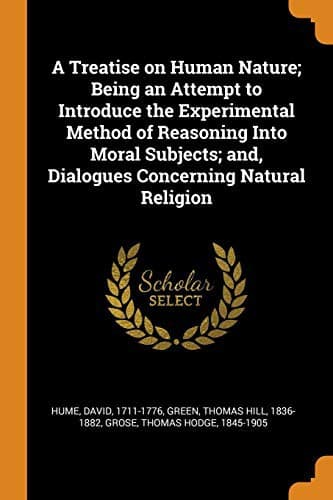
A Treatise of Human Nature: Being an Attempt to Introduce the Experimental Method Into Moral Subjects; and Dialogues Concerning Natural ReligionHume, David
PhilosophyPhilosophy
A Treatise of Human Nature: Being an Attempt to Introduce the Experimental Method Into Moral Subjects; and Dialogues Concerning Natural Religion
Hume, David
Emotions; Ethics; Knowledge, Theory of; Philosophy, English
54. On examining Locke’s second rehearsal of his theory in the fourth
book of the Essay--that ‘On Knowledge’--we are led to this result
quite as inevitably as in the book ‘On Ideas.’ He has a special
chapter on the ‘reality of human knowledge,’ where he puts the
problem thus:--‘It is evident the mind knows not things immediately,
but only by the intervention of the ideas it has of them. Our
knowledge therefore is real only so far as there is a conformity
between our ideas and the reality of things. But what shall be here
the criterion? How shall the mind, when it perceives nothing but its
own ideas, know that they agree with things themselves?’ (Book IV.
chap. iv. sec. 3.) It knows this, he proceeds to show, in the case
of simple ideas, because ‘since the mind can by no means make them
to itself, they must be the product of things operating on the mind
in a natural way. ... Simple ideas are not fictions of our fancies,
but the natural and regular productions of things without us, really
operating upon us; and so carry with them all the conformity which
is intended, or which our state requires, for they represent to us
things under those appearances which they are fitted to produce in
us; whereby we are enabled to distinguish the sorts of particular
substances,’ &c. &c. (Book IV. chap. iv. sec. 4.) The whole force
of this passage depends on the notion that simple ideas are already
to the subject of them not his own making, but the product of a
thing, which in its relation to these ideas is a ‘particular sort of
substance.’ It is the reception of such ideas, so related, that Locke
calls ‘sensitive knowledge of particular existence,’ or a ‘perception
of the mind, employed about the particular existence of finite
beings without us.’ (Book IV. chap. ii. sec. 14.) This, however, he
distinguishes from two other ‘degrees of knowledge or certainty,’
‘intuition’ and ‘demonstration,’ of which the former is attained when
the agreement or disagreement of two ideas is perceived immediately,
the latter when it is perceived mediately through the intervention
of certain other agreements or disagreements (less or more), each of
which must in turn be perceived immediately. Demonstration, being
thus really but a series of intuitions, carries the same certainty
as intuition, only it is a certainty which it requires more or less
pains and attention to apprehend. (Book IV. chap. ii. sec. 4.) Of
the ‘other perception of the mind, employed about the particular
existence of finite beings without us,’ which ‘passes under the
name of knowledge,’ he explains that although ‘going beyond bare
probability, it reaches not perfectly to either of the foregoing
degrees of certainty.’ ‘There can be nothing more certain,’ he
proceeds, ‘than that the idea we receive from an external object
is in our minds; this is intuitive knowledge. But whether there be
anything more than barely that idea in our minds, whether we can
Public-domain text, read in full here on John Shaqi.
Reviews
Reviews
No reviews yet
Be the first to share your thoughts on this work.
Elsewhere in the archive
Join the Discussion
Join the discussion
Sign in to leave a comment or review.
Sign InorCreate an account