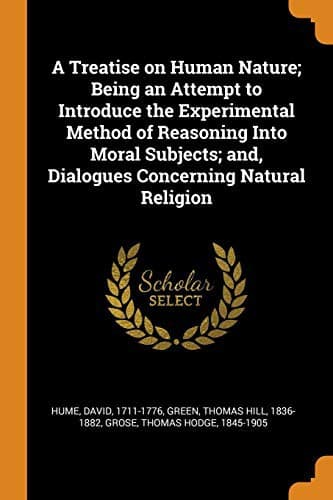
A Treatise of Human Nature: Being an Attempt to Introduce the Experimental Method Into Moral Subjects; and Dialogues Concerning Natural ReligionHume, David
PhilosophyPhilosophy
A Treatise of Human Nature: Being an Attempt to Introduce the Experimental Method Into Moral Subjects; and Dialogues Concerning Natural Religion
Hume, David
Emotions; Ethics; Knowledge, Theory of; Philosophy, English
59. Upon the ‘knowledge of the existence of things,’ thus
established, it has to be remarked in the first place that, after
all, according to Locke’s explicit statement, it is not properly
knowledge. It is ‘an assurance that deserves the name of knowledge’
(Book IV. chap. ii. sec. 14, and xi. sec. 3), yet being neither
itself an intuition of agreement between ideas, nor resoluble into a
series of such intuitions, the definition of knowledge excludes it.
Only if existence were itself an ‘idea,’ would the consciousness of
the agreement of the idea with it be a case of knowledge; but to make
existence an idea is to make the whole question about the agreement
of ideas, as such, with existence, as such, unmeaning. To seek escape
from this dilemma by calling the consciousness of the agreement
in question an ‘assurance’ instead of knowledge is a mere verbal
subterfuge. There can be no assurance of agreement between an idea
and that which is no object of consciousness at all. If, however,
existence is an object of consciousness, it can, according to Locke,
be nothing but an idea, and the question as to the _assurance_
of agreement is no less unmeaning than the question as to the
_knowledge_ of it. The raising of the question in fact, as Locke puts
it, implies the impossibility of answering it. It cannot be raised
with any significance, unless existence is external to and other than
an idea. It cannot be answered unless existence is, or is given in,
an object of consciousness, _i.e._ an idea.
Locke’s account of the testimony of sense renders his question as to
its veracity superfluous.
Public-domain text, read in full here on John Shaqi.
Reviews
Reviews
No reviews yet
Be the first to share your thoughts on this work.
Elsewhere in the archive
Join the Discussion
Join the discussion
Sign in to leave a comment or review.
Sign InorCreate an account