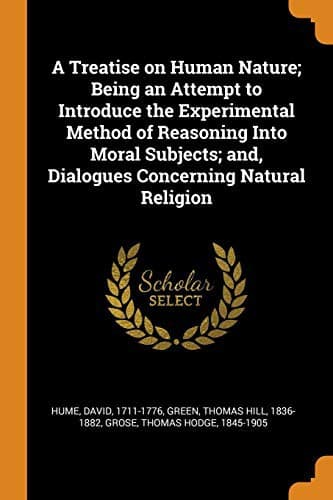
A Treatise of Human Nature: Being an Attempt to Introduce the Experimental Method Into Moral Subjects; and Dialogues Concerning Natural ReligionHume, David
PhilosophyPhilosophy
A Treatise of Human Nature: Being an Attempt to Introduce the Experimental Method Into Moral Subjects; and Dialogues Concerning Natural Religion
Hume, David
Emotions; Ethics; Knowledge, Theory of; Philosophy, English
73. When it is said that the idea of identity, or of any other
relation, is formed upon consideration of things as existing in a
certain way, this is naturally understood to mean--indeed, otherwise
it is unmeaning--that the things are first _known_ as existing, and
that afterwards the idea of the relation in question is formed. But
according to Locke, as we have seen, [1] the first and simplest act
of knowledge possible is the perception of identity between ideas.
Either then the ‘things,’ upon consideration of which the idea of
identity is formed, are not known at all, or the knowledge of them
involves the very idea afterwards formed on consideration of them.
Locke, having at whatever cost of self-contradiction to make his
theory fit the exigencies of language, virtually adopts the latter
alternative, though with an ambiguity of expression which makes a
definite meaning difficult to elicit. We have, however, the positive
statement to begin with, that the comparison in which the relation
originates, is of a thing with itself as existing at another time.
Again, the ‘ideas’ (used interchangeably with ‘things’), to which
identity is attributed, ‘vary not at all from what they were at
that moment wherein we consider their former existence.’ It is here
clearly implied that ‘things’ or ‘ideas’ _exist_, _i.e._ are given
to us in the spontaneous consciousness which we do not make, as each
one and the same throughout a multiplicity of times. This, again,
means that the relation of identity or sameness, _i.e._ unity of
thing under multiplicity of appearance, belongs to or consists in
the ‘very being’ of those given objects of consciousness, which
are in Locke’s sense the real, and upon which according to him all
relation is superinduced by an after-act of thought. So long as each
such object ‘continues to exist,’ so long its ‘sameness with itself
must continue,’ and this sameness is the complex idea, the relation,
of identity. Just as before, following Locke’s lead, we found the
simple idea, as the element of knowledge, become complex--a perceived
identity of ideas; so now mere existence, the ‘very being of things’
(which with Locke is only another name for the simple idea), resolves
itself into a relation, which it requires ‘consideration by the mind’
to constitute.
[1] See above, paragraph 25.
Locke fails to distinguish between identity and mere unity.
Public-domain text, read in full here on John Shaqi.
Reviews
Reviews
No reviews yet
Be the first to share your thoughts on this work.
Elsewhere in the archive
Join the Discussion
Join the discussion
Sign in to leave a comment or review.
Sign InorCreate an account