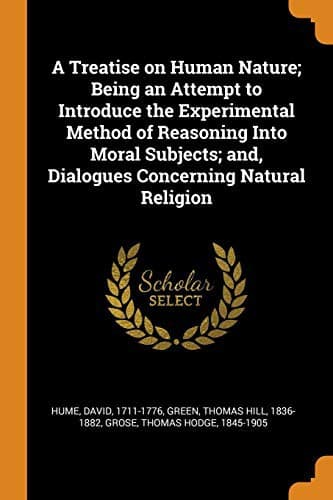
A Treatise of Human Nature: Being an Attempt to Introduce the Experimental Method Into Moral Subjects; and Dialogues Concerning Natural ReligionHume, David
PhilosophyPhilosophy
A Treatise of Human Nature: Being an Attempt to Introduce the Experimental Method Into Moral Subjects; and Dialogues Concerning Natural Religion
Hume, David
Emotions; Ethics; Knowledge, Theory of; Philosophy, English
77. ‘The very being of things,’ let it be noticed, according to
what Locke reckoned their ‘real,’ as distinct from their ‘nominal,’
essence. The consideration of this distinction has been hitherto
postponed; but the discussion of the relation of identity, as
subsisting between the parts of a ‘continued body,’ brings us upon
the doctrine of matter and its ‘primary qualities,’ which cannot be
properly treated except in connection with the other doctrine (which
Locke unhappily kept apart) of the two sorts of ‘essence.’ So far,
it will be remembered, the ‘facts’ or _given_ ideas, which we have
found him unawares converting into theories or ‘invented’ ideas, have
been those of the ‘secondary qualities of body.’ [1] It is these
which are united into things or substances, having been already
‘found in them:’ it is from these that we ‘infer’ the relation of
cause and effect, because as ‘vicissitudes of things’ or ‘affections
of sense’ they presuppose it: it is these again which, as ‘received
from without,’ testify the present existence of something, because
in being so received they are already interpreted as ‘appearances
of something.’ That the ‘thing,’ by reference to which these ideas
are judged to be ‘real,’ ‘adequate,’ and ‘true’--or, in other words,
become elements of a knowledge--is yet itself according to Locke’s
doctrine of substance and relation a ‘fiction of thought,’ has been
sufficiently shown. That it is so no less according to his doctrine
of essence will also appear. The question will then be, whether
by the same showing the ideas of body, of the self, and of God,
can be other than fictions, and the way will be cleared for Hume’s
philosophic adventure of accounting for them as such.
[1] See above, paragraph 20.
This repeats the inconsistency found in his doctrine of substance.
78. In Locke’s doctrine of ‘ideas of substances,’ the ‘thing’
appeared in two inconsistent positions: on the one hand, as that in
which they ‘are found;’ on the other, as that which results from
their concretion, or which, such concretion having been made, we
accustom ourselves to suppose as its basis. This inconsistency,
latent to Locke himself in the theory of substance, comes to the
surface in the theory of essence, where it is (as he thought)
overcome, but in truth only made more definite, by a distinction of
terms.
Plan to be followed.
Public-domain text, read in full here on John Shaqi.
Reviews
Reviews
No reviews yet
Be the first to share your thoughts on this work.
Elsewhere in the archive
Join the Discussion
Join the discussion
Sign in to leave a comment or review.
Sign InorCreate an account