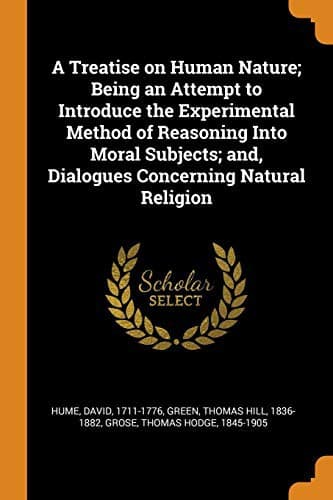
A Treatise of Human Nature: Being an Attempt to Introduce the Experimental Method Into Moral Subjects; and Dialogues Concerning Natural ReligionHume, David
PhilosophyPhilosophy
A Treatise of Human Nature: Being an Attempt to Introduce the Experimental Method Into Moral Subjects; and Dialogues Concerning Natural Religion
Hume, David
Emotions; Ethics; Knowledge, Theory of; Philosophy, English
95. We have already seen, [1] that if by a ‘particular being’ is
meant the mere _individuum_, as it would be upon abstraction of all
relations which according to Locke are fictitious, and constitute
a community or generality, it certainly can have no essential
qualities, since it has no qualities at all. It is a something which
equals nothing. The notion of this bare _individuum_ being the
real is the ‘protoplasm’ of Locke’s philosophy to which, though he
never quite recognized it himself, after the removal of a certain
number of accretions we may always penetrate. It is so because his
unacknowledged method of finding the real consisted in abstracting
from the formed content of consciousness till he came to that which
could not be got rid of. This is the momentarily present relation
of subject and object, which, considered on the side of the object,
gives the mere atom, and on the side of the subject, the mere ‘it is
felt.’ Even in this ultimate abstraction the ‘fiction of thought’
still survives, for the atom is determined to its mere individuality
by relation to other individuals, and the feeling is determined to
the present moment or ‘the now’ by relation to other ‘nows.’
[1] See above, paragraph 45.
Body as qualified by circumstances of time and place.
96. To this ultimate abstraction, however, Locke, though constantly
on the road to it, never quite penetrates. He is farthest from
it--indeed, as far from it as possible--where he is most acceptable
to common sense, as in his ordinary doctrine of abstraction, where
the real, from which the process of abstraction is supposed to begin,
is already the individual in the fullness of its qualities, James
and John, this man or this gold. He is nearest to it when the only
qualification of the ‘particular being,’ which has to be removed by
thought in order to its losing its reality and becoming an abstract
idea, is supposed to consist in ‘circumstances of time and place.’
Such body Locke held to be subject of ‘primary qualities’: but are
these compatible with particularity in time?
Public-domain text, read in full here on John Shaqi.
Reviews
Reviews
No reviews yet
Be the first to share your thoughts on this work.
Elsewhere in the archive
Join the Discussion
Join the discussion
Sign in to leave a comment or review.
Sign InorCreate an account