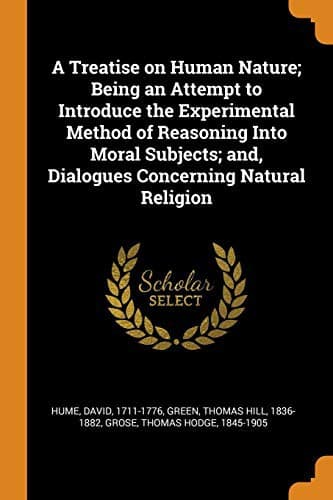
A Treatise of Human Nature: Being an Attempt to Introduce the Experimental Method Into Moral Subjects; and Dialogues Concerning Natural ReligionHume, David
PhilosophyPhilosophy
A Treatise of Human Nature: Being an Attempt to Introduce the Experimental Method Into Moral Subjects; and Dialogues Concerning Natural Religion
Hume, David
Emotions; Ethics; Knowledge, Theory of; Philosophy, English
[3] Cf. Book III. chap. vi. sec. 4: ‘Take but away the abstract
ideas by which we sort individuals and rank them under common names,
and then the thought of anything essential to any of them instantly
vanishes,’ &c.
How Locke avoids this question.
98. We have previously noticed [1] Locke’s pregnant remark, that
‘things whose existence is in succession’ do not admit of identity.
(Book II. chap, xxvii. sec. 2.) So far, then, as the ‘real,’ in
distinction from the ‘abstract,’ is constituted by particularity in
time, or has its existence in succession, it excludes the relation
of identity. ‘It perishes in every moment that it begins.’ Had Locke
been master of this notion, instead of being irregularly mastered
by it, he might have anticipated all that Hume had to say. As it
is, even in passages such as those to which reference has just been
made, where he follows its lead the farthest, he is still pulled up
by inconsistent conceptions with which common sense, acting through
common language, restrains the most adventurous philosophy. Thus,
even from his illustration of the liability of all existence to
change--‘that which was grass to-day is to-morrow the flesh of a
sheep, and within a few days after will become part of a man’ [2]--we
find that, just as he does not pursue the individualization of the
real in space so far but that it still remains ‘a constitution
of parts,’ so he does not pursue it in time so far but that a
coexistence of real elements over a certain duration is possible. To
a more thorough analysis, indeed, there is no alternative between
finding reality in relations of thought, which, because relations of
thought, are not in time and therefore are immutable, and submitting
it to such subdivision of time as excludes all real coexistence
because what is real, as present, at one moment is unreal, as past,
at the next. This alternative could not present itself in its
clearness to Locke, because, according to his method of interrogating
consciousness, he inevitably found in its supposed beginning, which
he identified with the real, those products of thought which he
opposed to the real, and thus read into the simple feeling of the
moment that which, if it were the simple feeling of the moment, it
could not contain. Thus throughout the Second Book of the Essay the
simple idea is supposed to represent either as copy or as effect a
permanent reality, whether body or mind: and in the later books, even
where the _representation_ of such reality in knowledge comes in
question, its existence as constituted by ‘primary qualities of body’
is throughout assumed, though general propositions with regard to it
are declared impossible. It is a feeling referred to body, or, in the
language of subsequent psychology, a feeling of the _outward_ sense,
[3] that Locke means by an ‘actual present sensation,’ and it is
properly in virtue of this reference that such sensation is supposed
to be, or to report, the real.
[1] See above, paragraph 75.
Public-domain text, read in full here on John Shaqi.
Reviews
Reviews
No reviews yet
Be the first to share your thoughts on this work.
Elsewhere in the archive
Join the Discussion
Join the discussion
Sign in to leave a comment or review.
Sign InorCreate an account