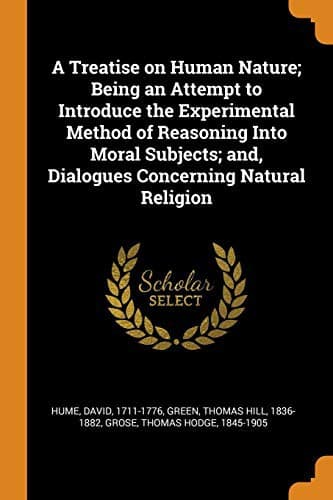
A Treatise of Human Nature: Being an Attempt to Introduce the Experimental Method Into Moral Subjects; and Dialogues Concerning Natural ReligionHume, David
PhilosophyPhilosophy
A Treatise of Human Nature: Being an Attempt to Introduce the Experimental Method Into Moral Subjects; and Dialogues Concerning Natural Religion
Hume, David
Emotions; Ethics; Knowledge, Theory of; Philosophy, English
[2] I write advisedly ‘touch’ only, not ‘sight and touch,’ because,
though Locke (Book II. chap, v.) speaks of the ideas of extension,
figure, motion, and rest of bodies, as received both by sight and
touch, these are all involved in the previous definition of solidity,
of which the idea is ascribed to touch only.
What knowledge can feeling, even as referred to a ‘solid’ body,
convey?
104. Let us now consider whether by this reference to body, feeling
becomes any the more a source of general knowledge concerning
matters of fact. As we have seen, if we identify the real with
feeling simply, its distinction from ‘bare vision’ disappears. This
difficulty it is sought to overcome by distinguishing feeling as
merely in the mind from actually present sensation. But on reflection
we find that sensation after all is feeling, and that one feeling
is as much present as another, though present only to become at
the next moment past, and thus, if it is the presence that is the
condition of reality, unreal. The distinction then must lie in the
_actuality_ of the sensation. But does not this actuality mean simply
derivation from the real, _i.e._ derivation from the idea which has
to be derived from it? If, in the spirit of Locke, we answer, ‘No,
it means that the feeling belongs to the outer sense’; the rejoinder
will be that this means either that it is a feeling of touch--and
what should give the feeling of touch this singular privilege over
other feelings of not being in the mind while they are in it?--or
that it is a feeling referred to body, which still implies the
presupposition of the real, only under the special relations of
resistance and impulse. The latter alternative is the one which
Locke virtually adopts, and in adopting it he makes the actuality,
by which sensation is distinguished from ‘feelings in the mind,’
itself a creation of the mind. But though it is by an intellectual
interpretation of the feeling of touch, not by the feeling itself,
that there is given that idea of body, by reference to which actual
sensation is distinguished from the mere idea, still with Locke the
feeling of touch is necessary to the interpretation. Thus, supposing
his notion to be carried out consistently, the actual present
sensation, as reporting the real, must either be a feeling of touch,
or, if of another sort, _e.g._, sight or hearing, must be referable
to an object of touch. In other words, the real will exist for us
so long only as it is touched, and ideas in us will constitute a
real essence so long only as they may be referred to an object now
touched. Let the object cease to be touched, and the ideas become
a nominal essence in the mind, the knowledge which they constitute
ceases to be real, and the proposition which expresses it ceases to
concern matter of fact. Truth as to matters of fact or bodies, then,
must be confined to singular propositions such as ‘this is touched
now,’ ‘that was touched then;’ ‘what is touched now is bitter,’ ‘what
Public-domain text, read in full here on John Shaqi.
Reviews
Reviews
No reviews yet
Be the first to share your thoughts on this work.
Elsewhere in the archive
Join the Discussion
Join the discussion
Sign in to leave a comment or review.
Sign InorCreate an account