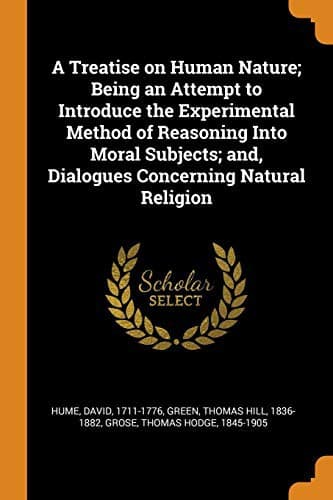
A Treatise of Human Nature: Being an Attempt to Introduce the Experimental Method Into Moral Subjects; and Dialogues Concerning Natural ReligionHume, David
PhilosophyPhilosophy
A Treatise of Human Nature: Being an Attempt to Introduce the Experimental Method Into Moral Subjects; and Dialogues Concerning Natural Religion
Hume, David
Emotions; Ethics; Knowledge, Theory of; Philosophy, English
106. Thus that reduction of reality to that of which nothing can be
said, which follows from its identification with particularity in
time, follows equally from its identification with the resistance
of body, or (which comes to the same) from the notion of an ‘outer
sense’ being its organ; since it is only that which _now_ resists,
not a general possibility of resistance nor a relation between the
resistances of different times, that can be regarded as outside the
mind. In Locke’s language, it is only a particular parcel of matter
that can be so regarded. Of such a parcel, as he rightly says, it is
absurd to ask what is its essence, for it can have none at all. (See
above, paragraph 94.) As real, it has no quality save that of being
a body or of being now touched--a quality, which as all things real
have it and have none other, cannot be a _differentia_ of it. When
we consider that this quality may be regarded equally as immutable
and as changing from moment to moment, we shall see the ground of
Locke’s contradiction of himself in speaking of the real thing
sometimes as indestructible, sometimes as in continual dissolution.
‘The real constitutions of things begin and perish with them.’ (Book
III. chap. iii. sec. 19.) That is, the thing at one moment makes an
impact on the sensitive tablet--in the fact that it does so lie at
once its existence and its essence--but the next moment the impact
is over, and with it thing and essence, _as real_, have disappeared.
Another impact, and thus another thing, has taken its place. But of
this the real essence is just the same as that of the previous thing,
namely, that it may be touched, or is solid, or a body, or a parcel
of matter; nor can this essence be really lost, since than it there
is no other reality, all difference of essence, as Locke expressly
says, [1] being constituted by abstract ideas and the work of the
mind. It follows that _real_ change is impossible. A parcel of matter
at one time is a parcel of matter at all times. Thus we have only to
forget that the relation of continuity between the parcels, not being
an idea caused by impact, should properly fall to the unreal--though
only on the same principle as should that of distinctness between the
times--and we find the real in a continuity of matter, unchangeable
because it has no qualities to change. It may seem strange that when
this notion of the formless continuity of the real being gets the
better of Locke, a man should be the real being which he takes as his
instance. ‘Nothing I have is essential to me. An accident or disease
may very much alter my colour or shape; a fever or fall may take away
my reason or memory, or both; and an apoplexy leave neither sense nor
understanding, no, nor life.’ (Book III. chap. vi. sec. 4.) But as
the sequel shows, the man or the ‘I’ is here considered simply as ‘a
particular corporeal being,’ _i.e._ as the ‘parcel of matter’ which
alone (according to the doctrine of reality now in view) can be the
Public-domain text, read in full here on John Shaqi.
Reviews
Reviews
No reviews yet
Be the first to share your thoughts on this work.
Elsewhere in the archive
Join the Discussion
Join the discussion
Sign in to leave a comment or review.
Sign InorCreate an account