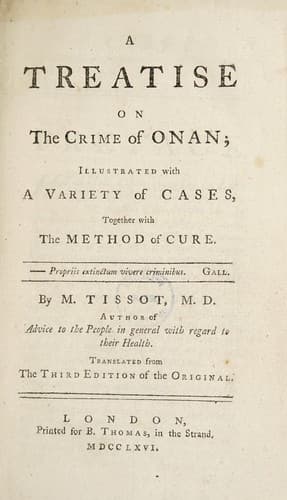
A Treatise on the Crime of Onan: Illustrated with a Variety of Cases, Together with the Method of CureTissot, S. A. D. (Samuel Auguste David)
Science
A Treatise on the Crime of Onan: Illustrated with a Variety of Cases, Together with the Method of Cure
Tissot, S. A. D. (Samuel Auguste David)
Masturbation -- Early works to 1800; Sexual ethics -- Early works to 1800
But do not let any one, by any means, from this last mentioned
observation, conclude against the utility of the precepts of the
most skillful masters in the art of surgery, who, grounding it on
other observations, strictly forbid coition to the wounded; there
is no practitioner that might not easily have convinced himself how
pernicious it must be to them. I shall only adduce one example, in which
self-pollution was mortal, and of which G. FABRI de Hilden has preserved
to us the history.
COSMUS SLOTAN had amputated the hand of a young man, that was shattered
by a gun-shot wound. As he knew him to be of a very hot constitution,
he had strictly forbid him any commerce with his wife, whom he likewise
apprized of the danger. But when all fear of the worst accidents was
dissipated, and the cure was proceeding in a fair way, the patient
finding desires come upon him, for which his wife refused to have the
complaisance he wanted of her, he, without coition, procured to himself
an emission of the _semen_, which was immediately followed by a fever, by
a delirium, by convulsions, and other violent symptoms, of which he died
in four days time[144].
I knew a young married man, who, having inconsiderately thrown himself
out of the seat of a _cabriolet_, (a chaise,) fell on his side; the
hind-wheel went over his foot, between the heel and the ancle-bone; there
was neither fracture nor luxation, but a considerable contusion: finding
himself recovered at the end of five days, he proceeded with his bride
as if he had had no such accident. Two hours afterwards his leg swelled,
with the most unsufferable torture, and he had a strong fever, which
lasted thirty hours.
But return we to the point. It is of great importance early to prevent
the progress of habit; and whatever may be the first cause of the
pollutions, not to suffer them to grow upon one. When they have been a
long while upon one, they are very hard to cure. “There is no disorder
(says HOFFMAN) that more torments the patients, nor gives more trouble to
physicians, than nocturnal pollutions, when they have lasted a long time,
and become habitual, especially if they return every night. The very best
remedies are almost always in vain employed; they even often do more harm
than good[145].”
Public-domain text, read in full here on John Shaqi.
Reviews
Reviews
No reviews yet
Be the first to share your thoughts on this work.
Elsewhere in the archive
Join the Discussion
Join the discussion
Sign in to leave a comment or review.
Sign InorCreate an account