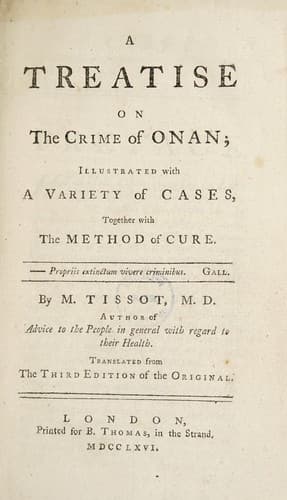
A Treatise on the Crime of Onan: Illustrated with a Variety of Cases, Together with the Method of CureTissot, S. A. D. (Samuel Auguste David)
Science
A Treatise on the Crime of Onan: Illustrated with a Variety of Cases, Together with the Method of Cure
Tissot, S. A. D. (Samuel Auguste David)
Masturbation -- Early works to 1800; Sexual ethics -- Early works to 1800
“Let those (says he) who deny that the difference of aliments can render
some temperate, others dissolute; some chaste, others incontinent; some
courageous, others cowardly; some meek, others quarrelsome; some modest,
others overbearing; let those, I say, who deny this truth, come to me;
let them follow my counsels as to eating and drinking, and I promise
them, that they will find great helps therefrom towards moral philosophy;
they will especially feel the faculties of their soul gather greater
strength; they will improve their natural genius, they will acquire more
memory, more prudence, more diligence. I will also tell them what kind of
liquors, what winds, what state of the air, what climates they ought to
shun or chuse[130].”
HIPPOCRATES, PLATO, ARISTOTLE, PLUTARCH, had already left us some very
good things on this important matter, and among the works which remain to
us of the Pythagorean PORPHYRY, that zealous anti-christian of the third
century, there is one, _upon the abstinence of the animal food_, in
which he reproaches FIRMUS CASTRICIUS, to whom he addresses it, for his
having quitted the vegetable diet, though he himself had owned it was the
fittest to preserve health, and to facilitate the study of philosophy;
and he adds, “Since you have taken to the eating of flesh-meat, your
own experience has taught you, that that confession of yours was well
grounded.” There are some very good things in that work.
The most efficacious preservative, the most infallible one is, doubtless,
that which is pointed out by that great man, who, of all men has the
best known his fellow creatures, and all their ways; who has not only
seen what they actually are, but what they have been, what they ought to
be, and what they are capable of becoming; who has the most truly loved
them; who has made the greatest efforts in their favor, and who has been
the most cruelly persecuted by them. “Watch with care (says he) over the
young man. Do not leave him alone either by day or by night. Sleep, at
least, in the same room with him. From the instant that he shall have
contracted that habit, the most fatal one that a young man can inslave
himself to, he will carry to the grave the melancholic effects of it. He
will have his body and his heart for ever enervated by it.” I refer to
the work itself for a perusal of all the excellent things he has said on
this matter[131].
Public-domain text, read in full here on John Shaqi.
Reviews
Reviews
No reviews yet
Be the first to share your thoughts on this work.
Elsewhere in the archive
Join the Discussion
Join the discussion
Sign in to leave a comment or review.
Sign InorCreate an account