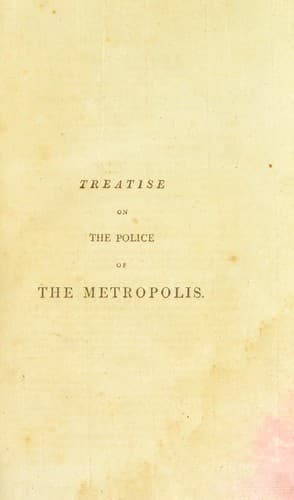
A Treatise on the Police of the Metropolis: Containing a Detail of the Various Crimes and Misdemeanors by which Public and Private Property and Security are, at Present, Injured and Endangered: and Suggesting Remedies for their PreventionColquhoun, Patrick
History
A Treatise on the Police of the Metropolis: Containing a Detail of the Various Crimes and Misdemeanors by which Public and Private Property and Security are, at Present, Injured and Endangered: and Suggesting Remedies for their Prevention
Colquhoun, Patrick
Crime -- England -- London; Police -- England -- London
The practice seems to have originated in a connection which was formed
between the Mates of West India ships[55] and the criminal Receivers,
residing near the river, who were accustomed to assail them under the
pretence of purchasing what is called _sweepings_, or in other words,
the spillings or drainings of sugars, which remained in the hold and
between the decks after the cargo was discharged. These sweepings were
claimed as a perquisite by a certain proportion of the Mates, contrary
to the repeated and express rules established by the Committee of
Merchants, who early saw the evils to which such indulgences would
lead, and in vain attempted to prevent it. The connivance, however, of
the Revenue officers became necessary to get these sweepings on
shore, and the quantity of spillings were gradually increased year
after year by fraudulent means, for the purpose of satisfying the
rapacity of all whose assistance and collusion was found necessary to
obtain the object in view.
[Footnote 55: It is not here meant to criminate all the Mates of ships
in this trade; for a large proportion are known to be men worthy of
the trust reposed in them.]
The connection thus formed, and the necessary facilities obtained,
from the sale of sweepings, recourse was at length had to the disposal
of as much of the cargo as could be obtained by a licence to nightly
plunderers, composed of Receivers, Coopers, Watermen, and Aquatic
Labourers, who having made a previous agreement with the Mate and
Revenue Officers, were permitted, on paying from thirty to fifty
guineas, to come on board in the night,--to open as many hogsheads of
sugar as were accessible,--and to plunder without controul. For this
purpose, a certain number of bags dyed black, and which went under the
appellation of _Black Strap_, were provided.--The Receivers, Coopers,
Watermen, and Lumpers, went on board at the appointed time, for all
these classes were necessary. The hogsheads of sugar and packages of
coffee, &c. were opened; the black bags were filled with the utmost
expedition and carried to the Receivers, and again returned to be
refilled until daylight, or the approach of it, stopped the pillage
for a few hours. On the succeeding night the depredations were again
renewed; and thus, on many occasions, from fifteen to twenty hogsheads
of sugar and a large quantity of coffee, and also in some instances
rum (which was removed by means of a small pump called a Jigger, and
filled into bladders with nozzels,) were plundered in a single ship,
in addition to the excessive depredations which were committed in the
same ships by the Lumpers or labourers who were employed during the
day in the discharge of the cargo.--Instances have been adduced, and
judicially proved, of various specific ships having been plundered in
an excessive degree in this manner; and it has been estimated upon
credible authority, that previous to the establishment of the Marine
Public-domain text, read in full here on John Shaqi.
Reviews
Reviews
No reviews yet
Be the first to share your thoughts on this work.
Elsewhere in the archive
Join the Discussion
Join the discussion
Sign in to leave a comment or review.
Sign InorCreate an account