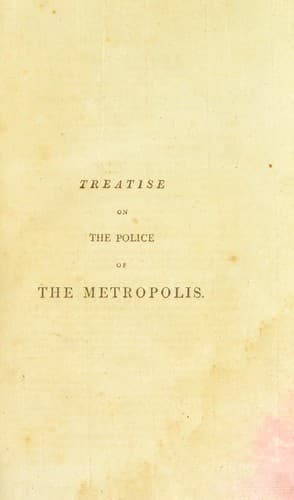
A Treatise on the Police of the Metropolis: Containing a Detail of the Various Crimes and Misdemeanors by which Public and Private Property and Security are, at Present, Injured and Endangered: and Suggesting Remedies for their PreventionColquhoun, Patrick
History
A Treatise on the Police of the Metropolis: Containing a Detail of the Various Crimes and Misdemeanors by which Public and Private Property and Security are, at Present, Injured and Endangered: and Suggesting Remedies for their Prevention
Colquhoun, Patrick
Crime -- England -- London; Police -- England -- London
The common Law, as well as the ancient Statutes of the kingdom, having
placed extensive powers in the hands of _Constables_ and _Peace
Officers_;--they are, in this point of view, to be considered as
_respectable_;--and it is the interest of the Community, that they
should support that rank and character in society, which corresponds
with the authority with which they are invested.--If this were
attended to, men of credit and discretion would not be so averse to
fill such situations; and those pernicious prejudices, which have
prevailed in vulgar life, and in some degree among the higher ranks in
Society, with regard to _thief-takers_, would no longer operate; for
it is plain to demonstration, "_that the best laws that ever were made
can avail nothing, if the Public Mind is impressed with an idea, that
it is a matter of infamy, to become the casual or professional agents
to carry them into execution_."
This absurd prejudice against the office of Constable, and the small
encouragement which the major part receive, is one of the chief
reasons why unworthy characters have filled such situations; and why
the public interest has suffered by the increase of crimes.
The office of Constable is as old as the Monarchy of England;--and
certainly existed in the time of the Saxons.[99]--The law requires
that he should be _idoneus homo_: or in other words, _to have honesty
to execute the office without malice, affection, or partiality;
knowledge to understand what he ought to do; and ability, as well in
substance or estate, as in body_, to enable him to conduct himself
with utility to the public.
[Footnote 99: Fineux.]
The Statute of Winchester, made in the 13th year of Edward the First
(anno 1285) appoints two Constables to be chosen in every Hundred; and
such seems to have been the attention of the Legislature to the Police
of the Country at that early period of our history, "_that suspicious
night-walkers are ordered to be arrested and detained by the
watch_."[100]
[Footnote 100: Winton, chap. 4.]
The Statute of 5 Edward III. _cap._ 14, (anno 1332) empowers
Constables "_to arrest persons suspected of man-slaughter, felonies,
and robberies, and to deliver them to the Sheriff, to be kept in
prison till the coming of the Justices_:" and another Act of the 34th
of the same reign, _cap._ 1, (made anno 1361,) empowers Justices,
(_inter alia_) "_to inquire after wanderers, to arrest and imprison
suspicious persons, and to oblige persons of evil fame to give
security for good behaviour; so that the People may not be troubled by
rioters, nor the peace blemished; nor Merchants and others travelling
on the highways be disturbed or put in peril by such offenders_."
Public-domain text, read in full here on John Shaqi.
Reviews
Reviews
No reviews yet
Be the first to share your thoughts on this work.
Elsewhere in the archive
Join the Discussion
Join the discussion
Sign in to leave a comment or review.
Sign InorCreate an account