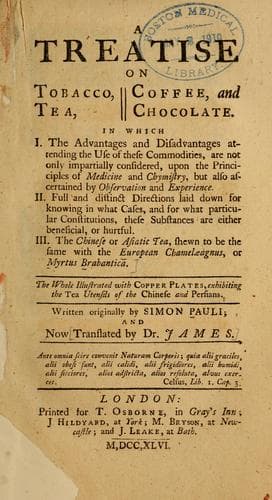
A Treatise on Tobacco, Tea, Coffee, and ChocolatePaulli, Simon
History
A Treatise on Tobacco, Tea, Coffee, and Chocolate
Paulli, Simon
Chocolate -- Early works to 1800; Coffee -- Early works to 1800; Tea -- Early works to 1800; Tobacco -- Early works to 1800
As it was expedient to compare my Description of the _Chinese Tea_
with those which _Dodonæus_ gives of the Herb _Betony_, and the
_Chamelæagnus_; so, in this Place, I think it proper to insert the
Descriptions which _Clusius_ has given of the _Pyrola Fruticans_, and
the _Spiræa Theophrasti_; the former of which he describes in the
following Manner: "One Genus of this Plant is sometimes of a shrubby
Nature; for new, short, and small Branches springing up every Year,
remain firm and green for some Years, and rise above the Earth, till by
their own Weight they bend downwards, hide themselves in the Ground,
and sometimes send out fibrous Roots. Two, three, or four small
carnous Leaves generally grow between the Nods: The superior Parts
of these Leaves are of a deep green Colour, and shining, whilst, in
Form and Bulk, they almost resemble those of the _Chamædaphne_, or
_Laureola_, only they are serrated about the Edges, and of an highly
drying and bitterish Taste, like the Leaves of the other Species of
_Pyrolæ_." These last Words ought carefully to be adverted to. The
same _Clusius_, in _Lib. 1._ in _Rarior Plantar. Histor._ describes
the _Spiræa_ in the following Manner: "It rises to about the Height
of two Cubits, with small Branches, or Twigs, covered with a reddish
Bark. Among these Branches arise, without any Order, numerous, long,
and narrow Leaves, resembling those of the Willow, serrated about
the Edges, with their superior Surfaces of a faint green, and their
inferior as if they were besprinkled with Verdegrease: They are of a
drying and kind of bitter Taste." The last Words of this Description
are also to be carefully adverted to, since the Leaves of _Tea_
are not only serrated, but also of a drying and bitter Taste. As,
therefore, the _Pyrola Fruticans_ of _Clusius_, and the _Spiræa_
of _Theophrastus_, and especially the former, are of a drying and
bitterish Taste, it is highly probable, that the _Chinese Tea_ may
be adulterated with one, or both of these; especially, since they
not only greatly resemble each other in Form, but also in Taste. A
Cut of one Leaf of the _Pyrola_, I have annexed to the Description
of _Scurvy-Grass_, in my _Quadripartitium_, No. 9. and another of a
_Tea-Leaf_, produced in _China_. As for a Cut of the _Spiræa_, the
Curious may have recourse to _Clusius_, or they may find one Leaf of
it accurately engraved in Plate 2, of this Work; where two Leaves of
_Chinese Tea_ are engraved. The larger of these is so like the _Spiræa_
of _Theophrastus_, both in Length, Breadth, Bulk, the Course of the
Veins, and the Disposition of the Crenations, that there is hardly the
smallest Possibility of distinguishing the one from the other: But both
these Leaves are vastly unlike to that _Tea_ Leaf which, in No. 7. of
the last cited Plate, I ordered to be engraved, with the _Cochlearia
Danica_: But the other small uncrenated Leaf is like the _Chinese Tea_,
as the latter is like the _Chamelæagnus_, which, as I have already
Public-domain text, read in full here on John Shaqi.
Reviews
Reviews
No reviews yet
Be the first to share your thoughts on this work.
Join the Discussion
Join the discussion
Sign in to leave a comment or review.
Sign InorCreate an account