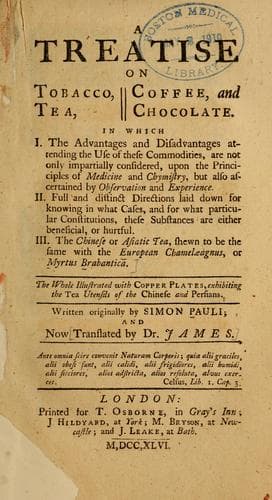
A Treatise on Tobacco, Tea, Coffee, and ChocolatePaulli, Simon
History
A Treatise on Tobacco, Tea, Coffee, and Chocolate
Paulli, Simon
Chocolate -- Early works to 1800; Coffee -- Early works to 1800; Tea -- Early works to 1800; Tobacco -- Early works to 1800
_Chinese_ Water is to be had in no Part of _Europe_. The same Author,
in his Description of the fifteenth Province, called _Junnam_, and its
Metropolis, tells us, "That in Mount _Xang_, situated to the _North_ of
the Town, there is a Spring of intensely cold Water, which, however,
is highly beneficial to paralitic Persons." He also tells us, that in
the same Province, there is a Spring called _Hiangkui_, which, in their
Language, signifies odoriferous Water, "Because it diffuses a fragrant
Scent, especially in the _Spring_, at which Time, the Inhabitants offer
Sacrifices to the Fountain, and drink Water, mixed with Wine, or
with a Liquor prepared of _Rice_. They also assert, that this Liquor
cures many Diseases." That these Waters are impregnated with Metallic
Particles, I have two Reasons to believe: First, Because _Martinius_
informs us, that the Rivulet near the City _Vusie_, flows from a
Fountain on a little Hill, called _Hoej_: The second is, that the
Waters of this Lake are conveyed to the remotest Provinces, even to the
Royal City, _Peking_, where they are used by the Grandees in preparing
their _Tea_. But the best Waters, when taken from the _Spring_, cannot
be long preserved from Corruption, unless they abound with a peculiar
Salt: Since the cold Mineral Waters of the _Spaw_, lose much of their
Virtue by being conveyed only into the Provinces adjacent to _Germany_.
Thus, it is sufficiently known to all the _Europeans_, that the _May_
Rains abound with Salt and Sulphur; in consequence of which, they keep
longer free from Corruption than other Waters. For this Reason, it is
customary among the _Papists_, to prepare their _Holy Water_ of _May_
Rain: See my _Digressio de Febribus Malignis_. But, lest these Reasons
should be esteemed conjectural, I shall farther prove, and confirm my
Opinion from _Martinius_, who, in the Place before quoted, speaks in
the following Manner: "It is not without Reason that the City _Gnihing_
receives that _Name_, which, in their Language, signifies the _Glory of
the Earth_; and which was bestowed upon it, because in it are made the
earthen Vessels, used in diluting, and drinking their _Tea_. The Reason
why these are preferred to the _Chinese_, though more transparent, and
diaphanous, is, because the former convey to the _Tea_, a certain Taste
and Smell, much admired by the _Chinese_; so that the Inhabitants of
that City are much employed in making them; and some of them are sold
at a Price equal, if not superior, to those of _Portugal_." Since,
therefore, these Vessels communicate to the _Tea_, both a Smell and
Taste, which are grateful to the _Chinese_; since the Cause of Taste
is a volatile Salt, and that of Smell a certain Sulphur; since this
Salt and Sulphur can hardly be separated by Chymistry; and since it
is peculiar to Salt to penetrate into the Essence of Things; it must
necessarily happen, that the Water, taken from the Lake, or River
Public-domain text, read in full here on John Shaqi.
Reviews
Reviews
No reviews yet
Be the first to share your thoughts on this work.
Elsewhere in the archive
Join the Discussion
Join the discussion
Sign in to leave a comment or review.
Sign InorCreate an account