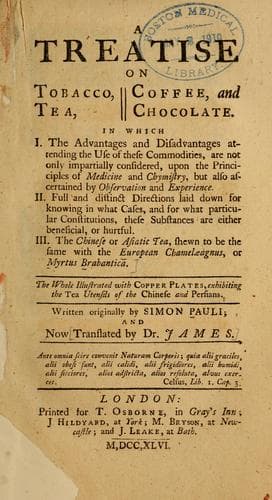
A Treatise on Tobacco, Tea, Coffee, and ChocolatePaulli, Simon
History
A Treatise on Tobacco, Tea, Coffee, and Chocolate
Paulli, Simon
Chocolate -- Early works to 1800; Coffee -- Early works to 1800; Tea -- Early works to 1800; Tobacco -- Early works to 1800
It is to be observed, that these Vessels are of a grateful fragrant
Smell, resembling those of the _Juniper_, _Cypress_, or _Aloes Tree_,
which is certainly owing to the bituminous Earth of which they
are formed. Thus we have before observed, that the _Kalenburgian_
bituminous Earth is as fragrant as Violets; and that, according to
_Martinius_, it is on account of the Fragrance of these Vessels, that
the _Chinese_ are so fond of them, and purchase them at such immense
Prices. We have also taken Notice from _Tulpius_, and _Maffæus_,
that these Pots, Vessels, and other Pieces of _Tea_ Equipage, are,
by the _Chinese_, bought at the Rate of some Thousand _Nobles_,
wrapped up in silken Coverings, shewn only to their nearest Friends,
and as much valued by them as Adamants, Gems, and curious Medals
are by the _Europeans_. Let the _Europeans_, therefore, before they
drink _Tea_, which itself is void of Smell, provide themselves with
the fragrant Vessels of _Gnihing_, and the Waters of the Rivulet
_Vussie_, which they must bring uncorrupted from _China_; and then,
on Supposition the Air was the same, which it is not, the same Effects
might be produced in _Europe_ by _Tea_, as those which it is boasted
to produce in _China_. It is therefore far more congruous to Truth
and Reason, to suppose, that the _Chinese_ are free from the Stone,
Gout, and arthritic Pains, rather by the Goodness of their Water,
than by their _Tea_ alone, which may also contribute something to
their Happiness in these Respects. Besides, the Force and Virtue of
_Tea_, must be considerably impaired and lost, by the intense Heat
of the Sun, during so long a Voyage, in which the _Equator_ must
be twice crossed, before the Ships arrive at any _European_ Ports.
Hence we know from Experience, that those Persons most consult the
Interest of the _Europeans_, who, according to _Mercator_, in his
Description of _China_, advise, that _Rhubarb_, with the best Sort of
which, _China_ abounds, should be brought through _Persia_ by Land,
lest it should be spoiled and corrupted by so long a Voyage. What
must therefore happen to _Tea_, or the _Chinese Chamelæagnus_, which
is in _China_ frequently toasted in an Iron Pan, so as to corrugate
and conglomerate its Leaves, according to _Rhodius_ and _Martinius_?
For, if the Virtues of _Rhubarb_, which is a compact Substance, are,
by such a Voyage, exhaled, this Misfortune must much more happen to
the tender Leaves of _Tea_, which are gathered in the _Spring_, and
have a bitterish Taste, but no Smell. Hence we may infer, that these
Leaves are, after their Arrival at _Europe_, possessed of a volatile
and fixed Salt, but deprived of their Sulphur, especially the most
volatile Part of it; for, if they were intirely destitute of Sulphur,
they would not take Flame, nor could they be burned. The Author of a
Book, intitled, _Artificia Hominum Miranda Naturæ in_ Sina & Europa,
in _Chap. 35._ tells us, "that in _Chekiang_, in _China_, there are
Public-domain text, read in full here on John Shaqi.
Reviews
Reviews
No reviews yet
Be the first to share your thoughts on this work.
Elsewhere in the archive
Join the Discussion
Join the discussion
Sign in to leave a comment or review.
Sign InorCreate an account