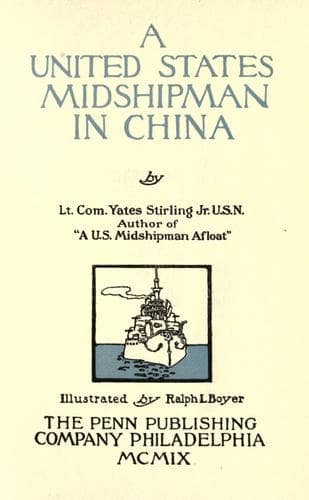
A United States Midshipman in ChinaStirling, Yates
General
A United States Midshipman in China
Stirling, Yates
China -- Juvenile fiction; United States. Navy -- Juvenile fiction
Dawn was breaking when the commander led his victorious men with the
rescued missionaries safely to the bank of the river, where small
boats were waiting to transport them to the protection of the American
war-ships. As the last of the refugees disembarked at the gangway of
the “Phœnix,” the sun peeped out from behind the distant hills.
Phil and Sydney longed for a few hours’ sleep, but they well knew that
if they succumbed to this desire they might miss altogether what they
felt would be the closing scenes in the drama.
By signal, Commander Hughes at once ordered that all non-combatants be
sent on board the gunboats, and that the monitors hold themselves in
readiness to get under way within the hour.
Phil’s hopes ran high as he and Sydney made themselves presentable
after their strenuous night’s experience.
After a hasty breakfast the lads appeared on deck. There they found
their captain before them, gazing closely through his binoculars at
the distant forts.
At the gangway three cutters were lying, and the landing force of the
“Phœnix,” rifles in hand, were standing in ranks ready to embark.
“March the men into the boats, Wilson,” Commander Hughes ordered
suddenly, putting his binoculars in their leather case. Then as he
turned to go below to his cabin, “Mr. Perry, you and Mr. Monroe report
to Mr. Wilson.”
“Where are we going?” Phil asked excitedly as he saluted the lieutenant.
“To the ‘Monterey,’” Lieutenant Wilson answered, “but that’s as far as
I know. The captain must expect hot work; each of my men is ordered to
take two hundred rounds of ammunition.”
“We’re going to storm the walled city,” Sydney exclaimed. “There’s no
sign of submission on either the forts or the viceroy’s yamen. The
captain means to rescue the four sailors and carry out his threats upon
Ku-Ling.”
Phil’s pulses beat faster at the thought. Now war had been declared,
and his captain believed in striking promptly before his enemy had time
to gather his forces!
Quickly the sailors were embarked in the waiting boats, and as
Commander Hughes, accompanied by Langdon, took his place in the stern
of the leading cutter, the oars were thrust out through the rowlocks
and the boats pulled with swift strokes alongside the monitor, anchored
only a few hundred yards down the river from the “Phœnix.”
“Get under way, Barnes,” Commander Hughes ordered as he stepped on
board the “Monterey,” “and signal the ‘Monadnock’ to follow us. Bend on
the signal to her to ‘clear ship for action’; the gunboats will remain
here out of range of the fort guns.”
The stirring call of the bugles sounded with its nerve-tingling ring
throughout the ship, repeated in a few minutes by the “Monadnock,” and
with a cheer of delight the crews disappeared below decks to their
stations for battle.
Inside of fifteen minutes all was in readiness, and the heavy anchors
were lifted from the bottom of the river.
Public-domain text, read in full here on John Shaqi.
Reviews
Reviews
No reviews yet
Be the first to share your thoughts on this work.
Elsewhere in the archive
Join the Discussion
Join the discussion
Sign in to leave a comment or review.
Sign InorCreate an account