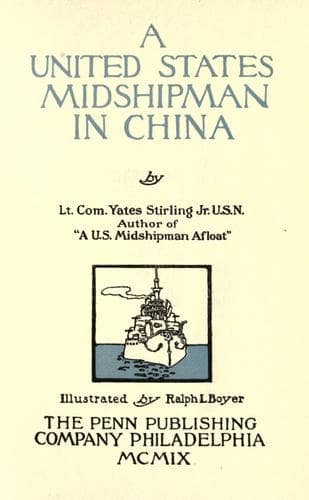
A United States Midshipman in ChinaStirling, Yates
General
A United States Midshipman in China
Stirling, Yates
China -- Juvenile fiction; United States. Navy -- Juvenile fiction
The cell was now entirely dark, save for a swinging light which
streamed through the barred doors. The midshipmen scarcely closed their
eyes during the long hours of the night, and when the first streaks of
day shone into their foul cell, they were sitting open-eyed on their
bench.
A jailer brought a basin of water to the door of the cell and then
entering, took off their irons and led them out into the courtyard.
The lads’ hopes rose, but they soon saw that it was to be only a
preparation for more imprisonment. A bowl of rice apiece was given
them, which was quickly eaten, and then each received a steaming cup of
tea. This reassuring meal put new life into the lads and they felt more
cheerful than at any time since their imprisonment.
“What’s he doing?” Sydney cried out in alarm, as the jailer began to
rub his neck with a damp rag, while another rubbed his wrists and
ankles. Phil was afterward given the same treatment, and then the
hateful irons were again put on, but in addition there were put about
their necks the dreaded rings, with the dangling brass tags that
jingled ominously.
The midshipmen were stunned. Like the others of their cell-mates they
were now wearing the badge of death. They also had been condemned by
the viceroy and would be held in this loathsome prison until their
numbers were called by the “Board of Punishments,” the Chinese high
court of justice.
Once more in their cell the lads sat dejectedly on their bench. They
had small desire for conversation; each felt his doom pressing upon
him, and strange to say with this weight of trouble their thoughts
turned to Langdon.
“If we are to be executed,” Phil said sorrowfully, “poor Langdon must
have already met his death.”
Sydney had not the heart to reply. He nodded his head sorrowfully. Then
a thought struck him, and he raised hopeful eyes to his companion’s
face.
“He must be near us, Phil,” he exclaimed. “Can’t we find some means of
communicating? If we could only talk their language we might ask our
jailer; he appears friendly and probably knows.”
Phil was silent for a few moments, then he suddenly began to whistle
loudly the stirring music of their class song. The tune brought tears
to Sydney’s eyes. It took him back to the day the brigade of midshipmen
marched by the reviewing stand for the last time with his class as
seniors. Two hours afterward, with his diploma in his hand, he had
shaken hands as a graduate with the secretary of the navy. What a
terrible contrast! Then a sudden fear took possession of him. Had Phil
lost his mind? Was the knowledge of their terrible end too much for
his nerves and had his strong mind succumbed? While these disquieting
thoughts were coursing through his brain, Phil ceased whistling and
listened eagerly. From a distance a high-pitched treble of a whistle
came indistinctly to their ears amid the noises of their cell.
Public-domain text, read in full here on John Shaqi.
Reviews
Reviews
No reviews yet
Be the first to share your thoughts on this work.
Elsewhere in the archive
Join the Discussion
Join the discussion
Sign in to leave a comment or review.
Sign InorCreate an account