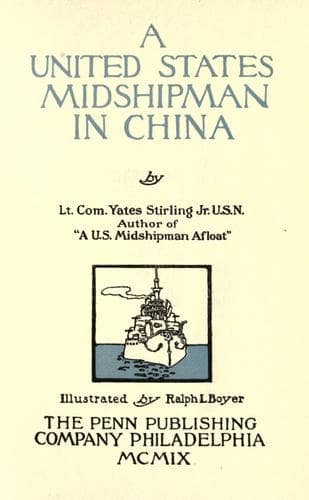
A United States Midshipman in ChinaStirling, Yates
General
A United States Midshipman in China
Stirling, Yates
China -- Juvenile fiction; United States. Navy -- Juvenile fiction
“Burn it up,” Langdon exclaimed indignantly. “That’s the way things are
run from a distance of ten thousand miles.” Then his glance encountered
the wide-open eyes of Ta-Ling and he snorted with rage as he roughly
jerked the bound Chinaman to his feet.
“Did you hear it?” he cried.
The mandarin’s eyes burned balefully as he nodded his head in assent.
Langdon released the Chinaman, and but for Phil’s steadying hand he
would have fallen to the floor. Then the pilot raised the long braided
cue of the interpreter and with a swift cut of his jack-knife severed
it close up to the Chinaman’s head; the next second, holding it out to
Phil, he cried gleefully:
“Put this on under your cap; it’s all you need to complete your costume.
“You won’t be so keen to show yourself in public hereafter,” he
continued spitefully to the mandarin.
Ta-Ling was beside himself with rage, but he could only grow red and
utter inarticulate sounds, while Langdon sat on the wooden bench
laughing scornfully at the disgraced official.
“If he doesn’t commit suicide in twenty-four hours, it’s because
he’s chicken-hearted.” Langdon laughed in a low tone, mainly for the
Chinaman’s ear. The pilot knew he held the secret of the cablegram.
Apparently he had guessed at the contents and was going to send it
together with the letter for the American captain. If the viceroy
knew the stand that was being taken by the American government, every
missionary in the valley of the Yangtse would be unsafe. The mandarin
officials in the towns of the provinces were as yet guarding the
foreigners against attack until they could be sure of the outcome at
Ku-Ling. Once the viceroy had humbled the foreign pride then the rabble
would be free to indulge its aroused hatred.
Phil cut short the pilot’s mirth by taking him by the arm and leading
him silently to the door. Once outside the cell the lad showed him the
sketch plan of the yamen with the path they must take to reach the room
where clothes would be found.
“If we only knew where the sailors are,” Sydney whispered.
Phil shook his head. It might only defeat them, and the sailors would
be no better off.
Langdon for the first time realized that he was not in the plot and
would have asked many questions, but Phil and Sydney grasped him firmly
on each side as if he were their prisoner and marched openly down the
stone pavement of the courtyard. The place indicated on the sketch was
easily found and Phil, leaving his companions, pushed the door quietly
open. The room was lighted by a single swinging lamp, while in one
corner sat a Chinaman reckoning laboriously on his abacus, a counting
device used by the Oriental races; the click of the small wooden balls
as he moved them along their wires sounded distinctly in the quiet of
the room.
Public-domain text, read in full here on John Shaqi.
Reviews
Reviews
No reviews yet
Be the first to share your thoughts on this work.
Elsewhere in the archive
Join the Discussion
Join the discussion
Sign in to leave a comment or review.
Sign InorCreate an account