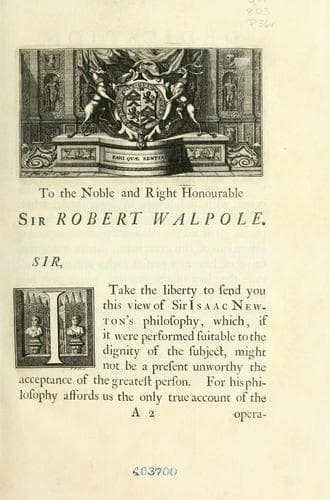
A View of Sir Isaac Newton's PhilosophyPemberton, Henry
Science
A View of Sir Isaac Newton's Philosophy
Pemberton, Henry
Newton, Isaac, 1642-1727. Principia
provided the elasticity arises from the centrifugal power of the
parts of the medium, as before explained, especially if the velocity
be so great, that this centrifugal power shall want time to exert it
self[119]. But it is to be observed, that in the proof of all this our
author proceeds upon the supposition of this centrifugal power in the
parts of the fluid; but if the elasticity be caused by the expansion
of the parts in the manner of wool compressed, and such like bodies,
by which the parts of the fluid will be in some measure entangled
together, and their motion be obstructed, the fluid will be in a manner
tenacious, and give a resistance upon that account over and above what
depends upon its elasticity only[120]; and the resistance derived from
that cause is to be judged of in the manner before set down.
15. IT is now time to pass to the second part of this theory; which
is to assign the measure of resistance, according to the proportion
between the density of the body and the density of the fluid. What
is here to be understood by the word density has been explained
above[121]. For this purpose as our author before considered two
distinct cases of bodies moving in mediums; one when they opposed
themselves to the fluid by their power of inactivity only, and another
when by ascending or descending their weight was combined with that
other power: so likewise, the fluids themselves are to be regarded
under a double capacity; either as having their parts at rest, and
disposed freely without restraint, or as being compressed together by
their own weight, or any other cause.
Public-domain text, read in full here on John Shaqi.
Reviews
Reviews
No reviews yet
Be the first to share your thoughts on this work.
Elsewhere in the archive
Join the Discussion
Join the discussion
Sign in to leave a comment or review.
Sign InorCreate an account