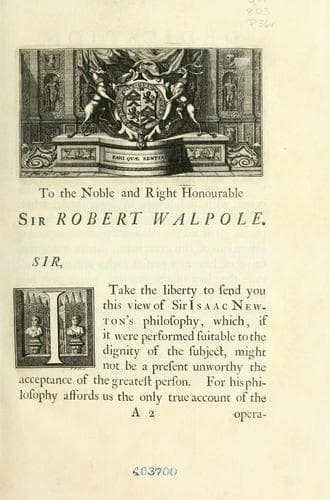
A View of Sir Isaac Newton's PhilosophyPemberton, Henry
Science
A View of Sir Isaac Newton's Philosophy
Pemberton, Henry
Newton, Isaac, 1642-1727. Principia
12. IT is farther to be observed, that as the planets do not move in
perfect circles round the sun; there is a greater distance between
their orbits in some places, than in others. For instance, the distance
between the orbit of Mars and Venus is near half as great again in one
part of their orbits, as in the opposite place. Now here the fluid,
in which the earth should swim, must move with a less rapid motion,
where there is this greater interval between the contiguous orbits; but
on the contrary, where the space is straitest, the earth moves more
slowly, than where it is widest[153].
13. FARTHER, if this our globe of earth swam in a fluid of equal
density with the earth it self, that is, in a fluid more dense than
water; all bodies put in motion here upon the earth’s surface must
suffer a great resistance from it; where as, by Sir ~ISAAC
NEWTON~’s experiments mentioned in the preceding chapter, bodies,
that fell perpendicularly down through the air, felt about 1/860 part
only of the resistance, which bodies suffered that fell in like manner
through water.
14. Sir ~ISAAC NEWTON~ applies these experiments yet farther,
and examines by them the general question concerning the absolute
plenitude of space. According to the Aristotelians, all space was
full without any the least vacuities whatever. DESCARTES embraced the
same opinion, and therefore supposed a subtile fluid matter, which
should pervade all bodies, and adequately fill up their pores. The
Atomical philosophers, who suppose all bodies both fluid and solid to
be composed of very minute but solid atoms, assert that no fluid, how
subtile soever the particles or atoms whereof it is composed should be,
can ever cause an absolute plenitude; because it is impossible that
any body can pass through the fluid without putting the particles of
it into such a motion, as to separate them, at least in part, from one
another, and so perpetually to cause small vacuities; by which these
Atomists endeavour to prove, that a vacuum, or some space empty of
all matter, is absolutely necessary to be in nature. Sir ~ISAAC
NEWTON~ objects against the filling of space with such a subtile
fluid, that all bodies in motion must be unmeasurably resisted by a
fluid so dense, as absolutely to fill up all the space, through which
it is spread. And lest it should be thought, that this objection might
be evaded by ascribing to this fluid such very minute and smooth parts,
as might remove all adhesion or friction between them, whereby all
resistance would be lost, which this fluid might otherwise give to
bodies moving in it; Sir ~ISAAC NEWTON~ proves, in the manner
above related, that fluids resist from the power of inactivity of their
particles; and that water and the air resist almost entirely on this
account: so that in this subtile fluid, however minute and lubricated
the particles, which compose it, might be; yet if the whole fluid was
as dense as water, it would resist very near as much as water does; and
Public-domain text, read in full here on John Shaqi.
Reviews
Reviews
No reviews yet
Be the first to share your thoughts on this work.
Elsewhere in the archive
Join the Discussion
Join the discussion
Sign in to leave a comment or review.
Sign InorCreate an account