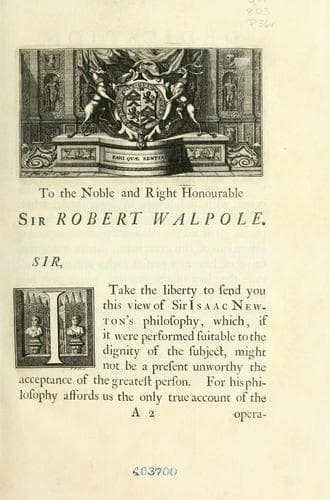
A View of Sir Isaac Newton's PhilosophyPemberton, Henry
Science
A View of Sir Isaac Newton's Philosophy
Pemberton, Henry
Newton, Isaac, 1642-1727. Principia
54. SIR ~ISAAC NEWTON~ shews farther, how, by comparing the
periods of the motion of the satellites, which revolve round Jupiter
and Saturn, with the period of our moon round the earth, and the
periods of those planets round the sun with the period of our earth’s
motion, the inequalities in the motion of those satellites may be
derived from the inequalities in the moon’s motion; excepting only in
regard to that motion of the axis of the orbit, which in the moon makes
the motion of the apogeon; for the orbits of those satellites, as far
as can be discerned by us at this distance, appearing little or nothing
eccentric, this motion, as deduced from the moon, must be diminished.
~CHAP. IV.~
Of ~Comets~.
IN the former of the two preceding chapters the powers have been
explained, which keep in motion those celestial bodies, whose courses
had been well determined by the astronomers. In the last chapter we
have shewn, how those powers have been applied by our author to the
making a more perfect discovery of the motion of those bodies, the
courses of which were but imperfectly understood; for some of the
inequalities, which we have been describing in the moon’s motion,
were unknown to the astronomers. In this chapter we are to treat of
a third species of the heavenly bodies, the true motion of which was
not at all apprehended before our author writ; in so much, that here
Sir ~ISAAC NEWTON~ has not only explained the causes of the motion of
these bodies, but has performed also the part of an astronomer, by
discovering what their motions are.
2. THAT these bodies are not meteors in our air, is manifest; because
they rise and set in the same manner, as the sun and stars. The
astronomers had gone so far in their inquiries concerning them, as to
prove by their observations, that they moved in the etherial spaces far
beyond the moon; but they had no true notion at all of the path, which
they described. The most prevailing opinion before our author was,
that they moved in straight lines; but in what part of the heavens was
not determined. DESCARTES[205] removed them far beyond the sphere of
Saturn, as finding the straight motion attributed to them, inconsistent
with the vortical fluid, by which he explains the motions of the
planets, as we have above related[206]. But Sir ISAAC NEWTON distinctly
proves from astronomical observation, that the comets pass through the
region of the planets, and are mostly invisible at a less distance,
than that of Jupiter[207].
Public-domain text, read in full here on John Shaqi.
Reviews
Reviews
No reviews yet
Be the first to share your thoughts on this work.
Elsewhere in the archive
Join the Discussion
Join the discussion
Sign in to leave a comment or review.
Sign InorCreate an account