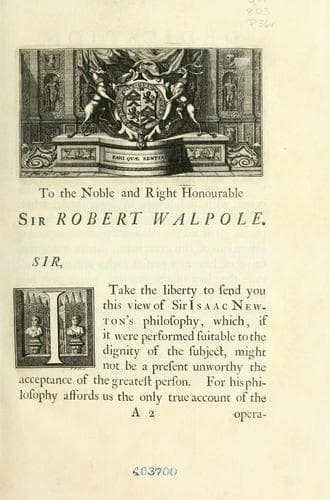
A View of Sir Isaac Newton's PhilosophyPemberton, Henry
Science
A View of Sir Isaac Newton's Philosophy
Pemberton, Henry
Newton, Isaac, 1642-1727. Principia
32. THE next thing to be considered is the effect, which these fluids
of the planets have upon the solid part of the bodies to which they
belong. And in the first place I shall shew, that it was necessary upon
account of these fluid parts to form the bodies of the planets into a
figure something different from that of a perfect globe. Because the
diurnal rotation, which our earth performs about its axis, and the
like motion we see in some of the other planets, (which is an ample
conviction that they all do the like) will diminish the force, with
which bodies are attracted upon all the parts of their surfaces, except
at the very poles, upon which they turn. Thus a stone or other weighty
substance resting upon the surface of the earth, by the force which it
receives from the motion communicated to it by the earth, if its weight
prevented not, would continue that motion in a straight line from the
point where it received it, and according to the direction, in which it
was given, that is, in a line which touches the surface at that point;
insomuch that it would move off from the earth in the same manner, as
a weight fasten’d to a string and whirled about endeavours continually
to recede from the center of motion, and would forthwith remove it self
to a greater distance from it, if loosed from the string which retains
it. And farther, as the centrifugal force, with which such a weight
presses from the center of its motion, is greater, by how much greater
the velocity is, with which it moves; so such a body, as I have been
supposing to lie on the earth, would recede from it with the greater
force, the greater the velocity is, with which the part of the earth’s
surface it rests upon is moved, that is, the farther distant it is from
the poles. But now the power of gravity is great enough to prevent
bodies in any part of the earth from being carried off from it by this
means; however it is plain that bodies having an effort contrary to
that of gravity, though much weaker than it, their weight, that is,
the degree of force, with which they are pressed to the earth, will
be diminished thereby, and be the more diminished, the greater this
contrary effort is; or in other words, the same body will weigh heavier
at either of the poles, than upon any other part of the earth; and if
any body be removed from the pole towards the equator, it will lose of
its weight more and more, and be lightest of all at the equator, that
is, in the middle between the poles.
Public-domain text, read in full here on John Shaqi.
Reviews
Reviews
No reviews yet
Be the first to share your thoughts on this work.
Elsewhere in the archive
Join the Discussion
Join the discussion
Sign in to leave a comment or review.
Sign InorCreate an account