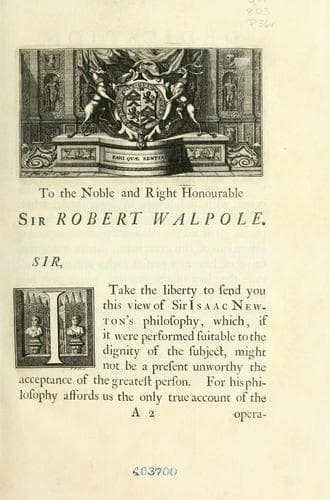
A View of Sir Isaac Newton's PhilosophyPemberton, Henry
Science
A View of Sir Isaac Newton's Philosophy
Pemberton, Henry
Newton, Isaac, 1642-1727. Principia
AFTER this view which has been taken of Sir ISAAC NEWTON’S mathematical
principles of philosophy, and the use he has made of them, in
explaining the system of the world, &c. the course of my design directs
us to turn our eyes to that other philosophical work, his treatise of
Optics, in which we shall find our great author’s inimitable genius
discovering it self no less, than in the former; nay perhaps even
more, since this work gives as many instances of his singular force
of reasoning, and of his unbounded invention, though unassisted in
great measure by those rules and general precepts, which facilitate
the invention of mathematical theorems. Nor yet is this work inferior
to the other in usefulness; for as that has made known to us one great
principle in nature, by which the celestial motions are continued, and
by which the frame of each globe is preserved; so does this point out
to us another principle no less universal, upon which depends all those
operations in the smaller parts of matter, for whose sake the greater
frame of the universe is erected; all those immense globes, with which
the whole heavens are filled, being without doubt only design’d as so
many convenient apartments for carrying on the more noble operations of
nature in vegetation and animal life. Which single consideration gives
abundant proof of the excellency of our author’s choice, in applying
himself carefully to examine the action between light and bodies, so
necessary in all the varieties of these productions, that none of them
can be successfully promoted without the concurrence of heat in a
greater or less degree.
2. ’TIS true, our author has not made so full a discovery of the
principle, by which this mutual action between light and bodies is
caused; as he has in relation to the power, by which the planets are
kept in their courses: yet he has led us to the very entrance upon it,
and pointed out the path so plainly which must be followed to reach it;
that one may be bold to say, whenever mankind shall be blessed with
this improvement of their knowledge, it will be derived so directly
from the principles laid down by our author in this book, that the
greatest share of the praise due to the discovery will belong to him.
3. IN speaking of the progress our author has made, I shall distinctly
pursue three things, the two first relating to the colours of natural
bodies: for in the first head shall be shewn, how those colours are
derived from the properties of the light itself; and in the second upon
what properties of the bodies they depend: but the third head of my
discourse shall treat of the action of bodies upon light in refracting,
reflecting, and inflecting it.
Public-domain text, read in full here on John Shaqi.
Reviews
Reviews
No reviews yet
Be the first to share your thoughts on this work.
Elsewhere in the archive
Join the Discussion
Join the discussion
Sign in to leave a comment or review.
Sign InorCreate an account