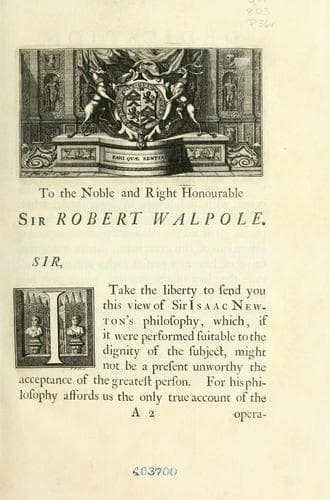
A View of Sir Isaac Newton's PhilosophyPemberton, Henry
Science
A View of Sir Isaac Newton's Philosophy
Pemberton, Henry
Newton, Isaac, 1642-1727. Principia
all along done; but it is more exact to ascribe to it something of a
yellowish tincture, occasioned by the brighter colours abounding in it;
which caution is necessary in examining the colours of the reflected
beam, when all the violet and blue are in it: for this yellowish turn
of the sun’s light causes the blue not to be quite so visible in it,
as it should be, were the light perfectly white; but makes the beam of
light incline rather towards a pale white.
~CHAP~. II.
Of the properties of BODIES, upon which their COLOURS depend.
AFTER having shewn in the last chapter, that the difference between
the colours of bodies viewed in open day-light is only this, that some
bodies are disposed to reflect rays of one colour in the greatest
plenty, and other bodies rays of some other colour; order now requires
us to examine more particularly into the property of bodies, which
gives them this difference. But this our author shews to be nothing
more, than the different magnitude of the particles, which compose each
body: this I question not will appear no small paradox. And indeed
this whole chapter will contain scarce any assertions, but what will
be almost incredible, though the arguments for them are so strong and
convincing, that they force our assent. In the former chapter have
been explained properties of light, not in the least thought of before
our author’s discovery of them; yet are they not difficult to admit,
as soon as experiments are known to give proof of their reality; but
some of the propositions to be stated here will, I fear, be accounted
almost past belief; notwithstanding that the arguments, by which they
are established are unanswerable. For it is proved by our author, that
bodies are rendered transparent by the minuteness of their pores, and
become opake by having them large; and more, that the most transparent
body by being reduced to a great thinness will become less pervious to
the light.
2. BUT whereas it had been the received opinion, and yet remains so
among all who have not studied this philosophy, that light is reflected
from bodies by its impinging against their solid parts, rebounding from
them, as a tennis ball or other elastic substance would do, when struck
against any hard and resisting surface; it will be proper to begin with
declaring our author’s sentiment concerning this, who shews by many
arguments that reflection cannot be caused by any such means[295]: some
few of his proofs I shall set down, referring the reader to our author
himself for the rest.
Public-domain text, read in full here on John Shaqi.
Reviews
Reviews
No reviews yet
Be the first to share your thoughts on this work.
Elsewhere in the archive
Join the Discussion
Join the discussion
Sign in to leave a comment or review.
Sign InorCreate an account