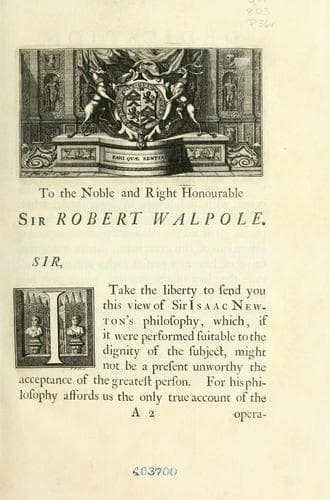
A View of Sir Isaac Newton's PhilosophyPemberton, Henry
Science
A View of Sir Isaac Newton's Philosophy
Pemberton, Henry
Newton, Isaac, 1642-1727. Principia
To this
may be added, that when the difference of the contiguous transparent
substances is the same, a colour reflected from the denser substance
reduced into a thin plate and surrounded by the rarer will be more
brisk, than the same colour will be, when reflected from a thin plate
formed of the rarer substance, and surrounded by the denser; as our
author experienced by blowing glass very thin at a lamp furnace,
which exhibited in the open air more vivid colours, than the air does
between two glasses. From these considerations it is manifest, that
if all other circumstances are alike, the densest bodies will be most
opake. But it was observed before, that these white metals can hardly
be made so thin, except by being dissolved in corroding liquors, as
to be rendred transparent; though none of them are so dense as gold,
which proves their great opacity to have some other cause besides their
density; and none is more fit to produce this, than such a size of
their particles, as qualifies them to reflect the white of the first
order.
18. FOR producing black the particles ought to be smaller than for
exhibiting any of the colours, viz. of a size answering to the
thickness of the bubble, where by reflecting little or no light it
appears colourless; but yet they must not be too small, for that will
make them transparent through deficiency of reflections in the inward
parts of the body, sufficient to stop the light from going through it;
but they must be of a size bordering upon that disposed to reflect
the faint blue of the first order, which affords an evident reason why
blacks usually partake a little of that colour. We see too, why bodies
dissolved by fire or putrefaction turn black: and why in grinding
glasses upon copper plates the dust of the glass, copper, and sand it
is ground with, become very black: and in the last place why these
black substances communicate so easily to others their hue; which is,
that their particles by reason of the great minuteness of them easily
overspread the grosser particles of others.
Public-domain text, read in full here on John Shaqi.
Reviews
Reviews
No reviews yet
Be the first to share your thoughts on this work.
Elsewhere in the archive
Join the Discussion
Join the discussion
Sign in to leave a comment or review.
Sign InorCreate an account