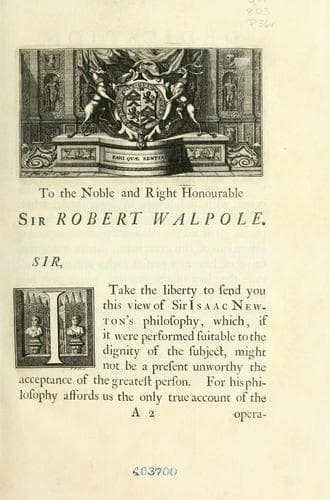
A View of Sir Isaac Newton's PhilosophyPemberton, Henry
Science
A View of Sir Isaac Newton's Philosophy
Pemberton, Henry
Newton, Isaac, 1642-1727. Principia
some point N, as a center, and describe with the same semidiameter
the circle O P Q. Let the angle under B I R be the least which the
refracted light can make with the surface A B, and the angle under F N
S the least which the refracted light can make with the surface E F.
Then if L T be drawn perpendicular to A B, and P V perpendicular to E
F; the whole power, wherewith the substance A B C D acts on the light,
will bear to the whole power wherewith the substance E F G H acts on,
the light, a proportion, which is duplicate of the proportion, which L
T bears to P V.
10. UPON comparing according to this rule the refractive powers of a
great many bodies it is found, that unctuous bodies which abound most
with sulphureous parts refract the light two or three times more in
proportion to their density than others: but that those bodies, which
seem to receive in their composition like proportions of sulphureous
parts, have their refractive powers proportional to their densities; as
appears beyond contradiction by comparing the refractive power of so
rare a substance as the air with that of common glass or rock crystal,
though these substances are 2000 times denser than air; nay the same
proportion is found to hold without sensible difference in comparing
air with pseudo-topar and glass of antimony, though the pseudo-topar
be 3500 times denser than air, and glass of antimony no less than
4400 times denser. This power in other substances, as salts, common
water, spirit of wine, &c. seems to bear a greater proportion to their
densities than these last named, according as they abound with sulphurs
more than these; which makes our author conclude it probable, that
bodies act upon the light chiefly, if not altogether, by means of the
sulphurs in them; which kind of substances it is likely enters in some
degree the composition of all bodies. Of all the substances examined
by our author, none has so great a refractive power, in respect of its
density, as a diamond.
11. OUR author finishes these remarks, and all he offers relating to
refraction, with observing, that the action between light and bodies is
mutual, since sulphureous bodies, which are most readily set on fire
by the sun’s light, when collected upon them with a burning glass, act
more upon light in refracting it, than other bodies of the same density
do. And farther, that the densest bodies, which have been now shewn to
act most upon light, contract the greatest heat by being exposed to the
summer sun.
Public-domain text, read in full here on John Shaqi.
Reviews
Reviews
No reviews yet
Be the first to share your thoughts on this work.
Elsewhere in the archive
Join the Discussion
Join the discussion
Sign in to leave a comment or review.
Sign InorCreate an account