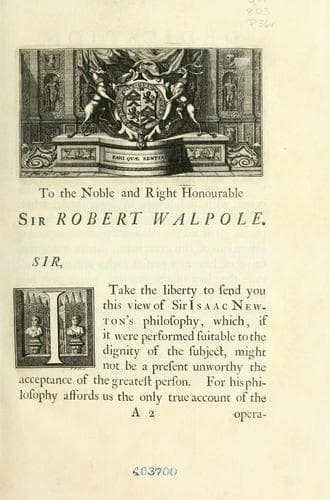
A View of Sir Isaac Newton's PhilosophyPemberton, Henry
Science
A View of Sir Isaac Newton's Philosophy
Pemberton, Henry
Newton, Isaac, 1642-1727. Principia
And the remaining colours, which fall without this space, as they are
much more dull and obscure than these, so will they be likewise much
more diffused; and therefore call hardly affect the sense in comparison
of the other. And agreeable to this is the observation of astronomers,
that telescopes between twenty and sixty feet in length represent the
fixed stars, as being about 5 or 6, at most about 8 or 10 seconds in
diameter. Whereas other arguments shew us, that they do not really
appear to us of any sensible magnitude any otherwise than as their
light is dilated by refraction. One proof that the fixed stars do not
appear to us under any sensible angle is, that when the moon passes
over any of them, their light does not, like the planets on the same
occasion, disappear by degrees, but vanishes at once.
21. OUR author being thus convinced, that telescopes were not
capable of being brought to much greater perfection than at present
by refractions, contrived one by reflection, in which there is no
separation made of the different coloured light; for in every kind of
light the rays after reflection have the same degree of inclination
to the surface, from whence they are reflected, as they have at their
incidence, so that those rays which come to the surface in one line,
will go off also in one line without any parting from one another.
Accordingly in the attempt he succeeded so well, that a short one, not
much exceeding six inches in length, equalled an ordinary telescope
whose length was four feet. Instruments of this kind to greater
lengths, have of late been made, which fully answer expectation[331].
~CHAP. V.~
Of the RAINBOW.
I SHALL now explain the rainbow. The manner of its production was
understood, in the general, before Sir ~ISAAC NEWTON~ had discovered
his theory of colours; but what caused the diversity of colours in it
could not then be known, which obliges him to explain this appearance
particularly; whom we shall imitate as follows. The first person, who
expressly shewed the rainbow to be formed by the reflection of the
sun-beams from drops of falling rain, was ANTONIO DE DOMINIS. But this
was afterwards more fully and distinctly explained by DESCARTES.
Public-domain text, read in full here on John Shaqi.
Reviews
Reviews
No reviews yet
Be the first to share your thoughts on this work.
Elsewhere in the archive
Join the Discussion
Join the discussion
Sign in to leave a comment or review.
Sign InorCreate an account