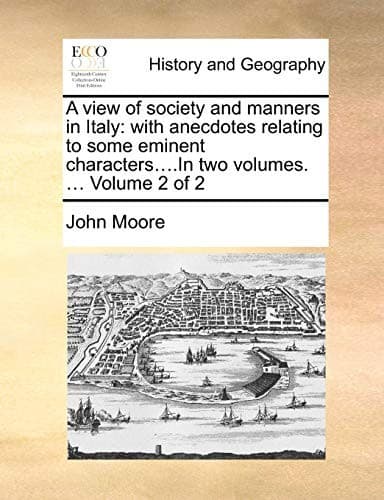
A View of Society and Manners in Italy, Volume 2 (of 2): With Anecdotes Relating to some Eminent CharactersMoore, John
History
A View of Society and Manners in Italy, Volume 2 (of 2): With Anecdotes Relating to some Eminent Characters
Moore, John
Italy -- Description and travel -- Early works to 1800; Italy -- Social life and customs -- Early works to 1800
The palace at Casserta was begun in the year 1750, after a plan of
Vanvitelli; the work is now carried on under the direction of his
son. While the present King of Spain remained at Naples, there were
generally about two thousand workmen employed; at present there are
about five hundred. It will be finished in a few years, and will then,
unquestionably, be one of the most spacious and magnificent palaces in
Europe. It has been said, that London is too large a capital for the
island of Great Britain; and it has been compared to a turgid head
placed on an emaciated body. The palace of Casserta also seems out
of proportion with the revenues of this kingdom. It is not, properly
speaking, a head too large for the body; but rather an ornament, by much
too expensive and bulky for either head or body. This palace is situated
about sixteen miles north from Naples, on the plain where ancient Capua
stood. It was thought prudent to found a building, on which such sums
of money were to be lavished, at a considerable distance from Mount
Vesuvius. It were to be wished, that the contents of the cabinet at
Portici were removed from the same dangerous neighbourhood. That he might
not be limited in ground for the gardens, may have been his Spanish
Majesty’s motive for choosing that his palace should be at a distance
from Naples; and that it might not be exposed to insult from an enemy’s
fleet, was probably the reason that determined him to place it at a
distance from the sea.
This immense building is of a rectangular form, seven hundred and fifty
feet English, by five hundred and eighty; about one hundred and twelve
feet high, comprehending five habitable stories, which contain such a
number of apartments as will accommodate the most numerous court, without
any accessary buildings.
The rectangle is divided into four courts, each of about two hundred
and fifty-two feet by one hundred and seventy. In each of the two
principal fronts, are three corresponding gates, forming three openings,
which pierce the whole building. The middle gate forms the entry to a
magnificent portico, through which the coaches drive. In the middle
of this, and in the centre of the edifice, there is a vestibule of an
octogonal form, which opens into the four grand courts at four sides of
the octogon; two other sides open into the portico, one to the staircase;
and, at the eighth side, there is a statue of Hercules, crowned by
Victory, with this inscription,
VIRTUS POST FORTIA FACTA CORONAT.
Public-domain text, read in full here on John Shaqi.
Reviews
Reviews
No reviews yet
Be the first to share your thoughts on this work.
Elsewhere in the archive
Join the Discussion
Join the discussion
Sign in to leave a comment or review.
Sign InorCreate an account