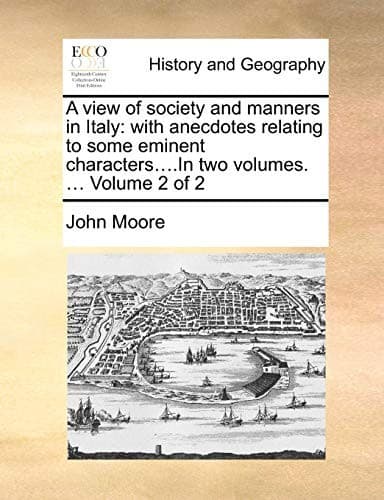
A View of Society and Manners in Italy, Volume 2 (of 2): With Anecdotes Relating to some Eminent CharactersMoore, John
History
A View of Society and Manners in Italy, Volume 2 (of 2): With Anecdotes Relating to some Eminent Characters
Moore, John
Italy -- Description and travel -- Early works to 1800; Italy -- Social life and customs -- Early works to 1800
The walls are adorned with a representation of Apollo and the Muses;
and some of that God’s adventures are painted in Fresco by Domenichino,
particularly the manner in which he treated Marsyas. This, in my humble
opinion, had better been omitted; both because it is a disagreeable
subject for a picture, and because it does no honour to Apollo. Marsyas
unquestionably was an object of contempt and ridicule, on account of
his presumption; but the punishment said to have been inflicted on him
exceeds all bounds, and renders the inflictor more detestable in our
eyes than the insolent satyr himself. This story is so very much out
of character, and so unlike the elegant god of poetry and music, that
I am inclined to suspect it is not true. There is a report, equally
incredible, which has been propagated by malicious people concerning his
sister Diana; I do not mean her rencounter with Actæon, for the Goddess
of Chastity may, without inconsistency, be supposed cruel, but it is
quite impossible to reconcile her general character with the stories of
her nocturnal visits to Endymion.
The villa Ludovisi is remarkable for its gardens and waterworks. The
hills on which Frescati is situated, afford great abundance of water, a
circumstance of which the owners of those villas have profited, all of
them being ornamented with fountains, cascades, or waterworks of some
kind or other.
The villa Taverna, belonging to the Prince Borghese, is one of the finest
and best furnished of any in the neighbourhood of Rome. From this you
ascend through gardens to Monte Dracone, another palace on a more lofty
situation, belonging also to that Prince, and deriving its name from the
arms of his family. The ancient city of Tusculum is supposed to have
stood on the spot, or very near it, where Frescati now is built; and at
the distance of about a mile and a half, it is generally believed, was
the Tusculan villa of Cicero, at a place now called Grotta Ferrata. Some
Greek monks of the order of St. Basil, flying from the persecution of the
Saracens in the eleventh century, were permitted to build a convent on
the ruins of Cicero’s famous house. They still perform the service in the
Greek language.
Whichever way you walk from Frescati, you have the most delightful
scenes before you. I passed two very agreeable days, wandering through
the gardens and from villa to villa. The pleasure of our party was not a
little augmented by the observations of Mr. B——, a lively old gentleman
from Scotland, a man of worth but no antiquarian, and indeed no admirer
of any thing, ancient or modern, which has not some relation to his
native country; but to ballance that indifference, he feels the warmest
regard for every thing which has. We extended our walks as far as the
lake of Nemi, a bason of water lying in a very deep bottom, about four
miles in circumference, whose surrounding hills are covered with tall and
shady trees. Here
Public-domain text, read in full here on John Shaqi.
Reviews
Reviews
No reviews yet
Be the first to share your thoughts on this work.
Elsewhere in the archive
Join the Discussion
Join the discussion
Sign in to leave a comment or review.
Sign InorCreate an account