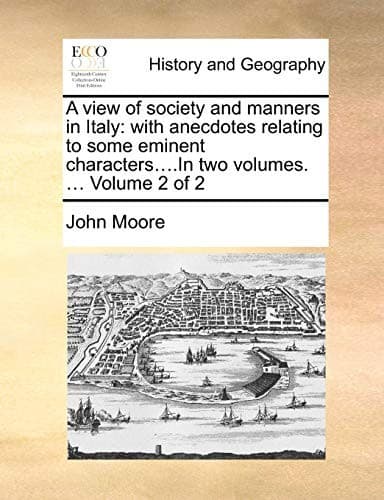
A View of Society and Manners in Italy, Volume 2 (of 2): With Anecdotes Relating to some Eminent CharactersMoore, John
History
A View of Society and Manners in Italy, Volume 2 (of 2): With Anecdotes Relating to some Eminent Characters
Moore, John
Italy -- Description and travel -- Early works to 1800; Italy -- Social life and customs -- Early works to 1800
From what has been thrown out by some celebrated wits, and the
common-place invective of those who affect that character, one would be
led to imagine that there is something in the nature of the clerical
profession which has a tendency to render men proud and oppressive.
Such indiscriminating censure carries no conviction to my mind, because
it is contradicted by the experience I have had in life, and by the
observations, such as they are, which I have been able to make on human
nature. I do not mean, in imitation of the satirists above mentioned, to
put the Clergy of all religions on the same footing. My opportunities of
knowledge are too slender to justify _that_; my acquaintance with this
order of men having been in a great measure confined to those of the
Protestant Church, men of learning and ingenuity, of quiet, speculative,
and benevolent dispositions; it is usually, indeed, this turn of mind
which has inclined them to the ecclesiastical profession. But though my
acquaintance with the Roman Catholic Clergy is very limited, yet the few
I do know could not be mentioned as exceptions to what I have just said
of the Protestant; and, exclusive of all personal knowledge of the men,
it is natural to think that the habitual performance of the ceremonies
of the Christian religion, though intermingled with some superstitious
rites, and the preaching the doctrines of benevolence and good-will
towards men, must have some influence on the lives and characters
of those who are thus employed. It is a common error, prevailing in
Protestant countries, to imagine that the Roman Catholic Clergy laugh at
the religion they inculcate, and regard their flocks as the dupes of an
artful plan of imposition. By far the greater part of Roman Catholic
priests and monks are themselves most sincere believers, and teach the
doctrines of Christianity, and all the miracles of the legend, with a
perfect conviction of their divinity and truth. The few who were behind
the curtain when falsehood was first embroidered upon truth, and those
who have at different periods been the authors of all the masks and
interludes which have enriched the grand drama of superstition, have
always chosen to employ such men, being sensible that the inferior actors
would perform their parts more perfectly, by acting from nature and real
conviction. “Paulum interesse censes,” says Davus to Mysis, “ex animo
omnia ut fert natura, facias an de industria[10].”
Public-domain text, read in full here on John Shaqi.
Reviews
Reviews
No reviews yet
Be the first to share your thoughts on this work.
Elsewhere in the archive
Join the Discussion
Join the discussion
Sign in to leave a comment or review.
Sign InorCreate an account