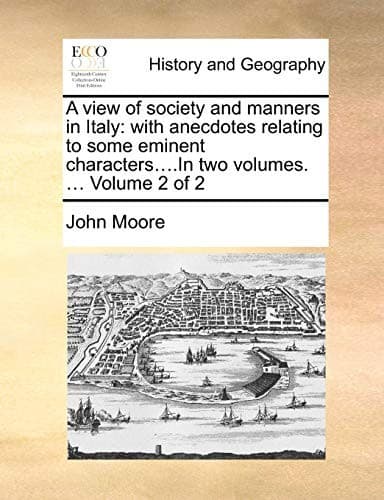
A View of Society and Manners in Italy, Volume 2 (of 2): With Anecdotes Relating to some Eminent CharactersMoore, John
History
A View of Society and Manners in Italy, Volume 2 (of 2): With Anecdotes Relating to some Eminent Characters
Moore, John
Italy -- Description and travel -- Early works to 1800; Italy -- Social life and customs -- Early works to 1800
Naples is celebrated for the finest opera in Europe. This however happens
not to be the season of performing; but the common people enjoy _their_
operas at all seasons. Little concerts of vocal and instrumental music
are heard every evening in the Strada Nuova, the Chiaca, the Strada di
Toledo, and other streets; and young men and women are seen dancing to
the music of ambulatory performers all along this delightful bay. To a
mere spectator, the amusements of the common people afford more delight,
than those of the great; because they seem to be more enjoyed by the
one class, than by the other. This is the case every where, except in
France; where the high appear as happy as those of middle rank, and the
rich are very near as merry as the poor. But, in most other countries,
the people of great rank and fortune, though they flock to every kind of
entertainment, from not knowing what to do with themselves, yet seem to
enjoy them less than those of inferior rank and fortune.
The English particularly are said to be in this predicament. This may
be true in some degree; though I imagine there is more appearance than
reality in it; owing to an absurd affectation of indifference, or what
the French call _nonchalance_, which has prevailed of late years. A few
insipid characters in high life, whose internal vacancy leads them to
seek amusement in public places, and whose insensibility prevents them
from finding it, have probably brought this appearance of a want of all
enjoyment into fashion. Those who wish to be thought of what is called
the _ton_, imitate the mawkish insipidity of their superiors in rank,
and imagine it distinguishes them from the vulgar, to suppress all the
natural expressions of pity, joy, or admiration, and to seem, upon
all occasions, in a state of complete apathy. Those amiable creatures
frequent public places, that it may be said of them, _They are not as
other men are_. You will see them occasionally at the playhouse, placed
in the boxes, like so many busts, with unchanging features; and, while
the rest of the audience yield to the emotions excited by the poet and
the actors, those men of the _ton_ preserve the most dignified serenity
of countenance; and, except that they from time to time pronounce
the words _Pshaw!_ and _Stuff!_—one would think them the express
representatives of the Pagan gods, who _have eyes but do not see, and
ears but do not hear_.
Public-domain text, read in full here on John Shaqi.
Reviews
Reviews
No reviews yet
Be the first to share your thoughts on this work.
Elsewhere in the archive
Join the Discussion
Join the discussion
Sign in to leave a comment or review.
Sign InorCreate an account