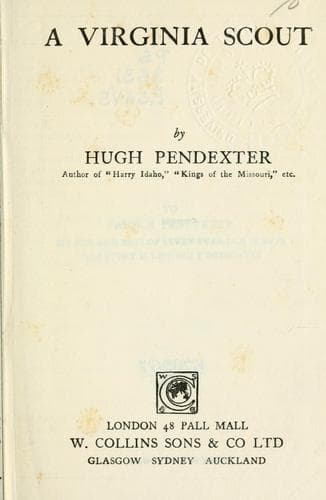
Frontier and pioneer life -- United States -- Fiction; Historical fiction; Lord Dunmore's War, 1774 -- Fiction
Many "Long Knives," as they called the Virginia militia, were flocking to
the Great Levels of the Greenbriar, and a forward movement of a whole army
was shortly to be expected. As the presence of a large force of our
riflemen so near Howard's Creek would insure the safety of that settlement
I knew it to be the proper ending of our journey.
I induced Patricia to remain in camp with the Indians while I went out and
shot a bear. The bear was very fat and I gave all the meat to the natives,
for which they were grateful. One of them had a smoothbore, but no powder.
I could spare him none.
Patricia was now convinced the Indians would not harm us, but she would
not consent to making camp near them. We walked several more miles before
she was willing to stop and cook the kettle.
My tally-stick gave the thirteenth of September as the date of our arrival
at Howard's Creek. The settlers informed me I had lost a day somewhere on
the long journey and that it was the fourteenth. Nearly all the young and
unmarried men were off to fight in Colonel Lewis' army, and many of the
heads of families, including Davis and Moulton.
Those who were left behind gave us a royal welcome. Uncle Dick, the aged
one, fell to sharpening his long knife with renewed vigor. Patricia and I
had been counted as dead. Dale's death had been reported by young Cousin,
and it caused no great amount of sorrow. The girl was never allowed to
suspect this indifference. In reply to my eager inquiries I was told that
Shelby Cousin was at the Great Levels, serving as a scout.
For once Howard's Creek felt safe. With nothing to worry about the men and
women became garrulous as crows. The children played "Lewis' Army" from
sunrise to sunset. The Widow McCabe swore she would put on a hunting-shirt
and breeches and go to war. The passing of men between the levels and the
creek resulted in some news and many rumors. The meeting-place at the
levels was called Camp Union. Colonel Lewis, pursuant to orders from
Governor Dunmore, had commenced assembling the Augusta, Botetourt and
Fincastle County troops at the levels on August twenty-seven. Cornstalk's
spies had served him well!
His Lordship was to lead an army, raised from the northwest counties and
from the vicinity of Fort Pitt, down the Ohio and unite with Colonel Lewis
at the mouth of the Great Kanawha. Colonel Charles Lewis, with some
Augusta and Botetourt troops, had left Camp Union on September sixth to
drive the cattle and four hundred pack-animals to the mouth of the Elk,
where he was to make canoes for transporting provisions to the Ohio.
The main army had marched from Camp Union on the twelfth, although Colonel
Lewis had received a letter from Dunmore, urging that the rendezvous be
changed to the mouth of the Little Kanawha. Colonel Lewis had replied it
was impossible to alter his line of march.
Public-domain text, read in full here on John Shaqi.
Reviews
Reviews
No reviews yet
Be the first to share your thoughts on this work.
Elsewhere in the archive
Join the Discussion
Join the discussion
Sign in to leave a comment or review.
Sign InorCreate an account